A parallel plate capacitor is connected to a battery. The plates are pulled apart with a uniform speed. If $x$ is the separation between the plates, the time rate of change of electrostatic energy of capacitor is proportional to
Medium


Download our appand get started for free
Experience the future of education. Simply download our apps or reach out to us for more information. Let's shape the future of learning together!No signup needed.*
Similar Questions
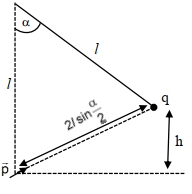
- 1A point charge $q$ of mass $m$ is suspended vertically by a string of length $l$. A point dipole of dipole moment $\overrightarrow{ p }$ is now brought towards $q$ from infinity so that the charge moves away. The final equilibrium position of the system including the direction of the dipole, the angles and distances is shown in the figure below. If the work done in bringing the dipole to this position is $N \times( mgh )$, where $g$ is the acceleration due to gravity, then the value of $N$ is. . . . . . (Note that for three coplanar forces keeping a point mass in equilibrium, $\frac{F}{\sin \theta}$ is the same for all forces, where $F$ is any one of the forces and $\theta$ is the angle between the other two forces)View Solution
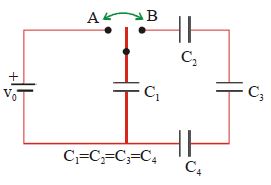
- 2The four identical capacitors in the circuit shown below are initially uncharged. The switch is then thrown first to position $A$, and then to position $B$. After this is done:View Solution
Note: $V_{1,2,3,4}$ are the potential differences across $C_{1,2,3,4}$ and $Q_{1,2,3,4}$ are the final charges stored in $C_{1,2,3,4}$ respectively.
- 3A $60\; pF$ capacitor is fully charged by a $20\; \mathrm{V}$ supply. It is then disconnected from the supply and is connected to another uncharged $60 \;pF$ capactior is parallel. The electrostatic energy that is lost in this process by the time the charge is redistributed between them is (in $nJ$)View Solution
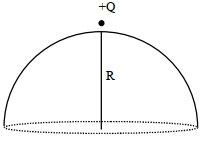
- 4A point charge $+Q$ is placed just outside an imaginary hemispherical surface of radius $R$ as shown in the figure. Which of the following statements is/are correct?View Solution
(IMAGE)
$[A]$ The electric flux passing through the curved surface of the hemisphere is $-\frac{\mathrm{Q}}{2 \varepsilon_0}\left(1-\frac{1}{\sqrt{2}}\right)$
$[B]$ Total flux through the curved and the flat surfaces is $\frac{Q}{\varepsilon_0}$
$[C]$ The component of the electric field normal to the flat surface is constant over the surface
$[D]$ The circumference of the flat surface is an equipotential
- 5The mean electric energy density between the plates of a charged capacitor is (here $q$= charge on the capacitor and $A$= area of the capacitor plate)View Solution
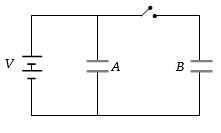
- 6Figure given below shows two identical parallel plate capacitors connected to a battery with switch $S$ closed. The switch is now opened and the free space between the plate of capacitors is filled with a dielectric of dielectric constant $3$. What will be the ratio of total electrostatic energy stored in both capacitors before and after the introduction of the dielectricView Solution
- 7The figure shows a family of parallel equipotential surfaces and four paths along which an electron is made to move from one surface to another as shown in the figurView Solution
$(I)$ What is the direction of the electric field ?
$(II)$ Rank the paths according to magnitude of work done, greatest first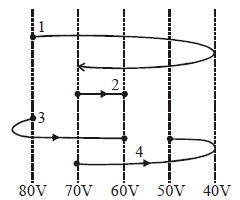
- 8The distance between ${H^ + }$ and $C{l^ - }$ ions in $HCl$ molecule is $1.28\,\mathop A\limits^o $. What will be the potential due to this dipole at a distance of $12\,\mathop A\limits^o $ on the axis of dipole......$V$View Solution
- 9A charge $+q$ is fixed at each of the points $x = x_0,\,x = 3x_0,\,x = 5x_0$, .... upto $\infty $ on $X-$ axis and charge $-q$ is fixed on each of the points $x = 2x_0,\,x = 4x_0,\,x = 6x_0$, .... upto $\infty $ . Here $x_0$ is a positive constant. Take the potential at a point due to a charge $Q$ at a distance $r$ from it to be $\frac{Q}{{4\pi {\varepsilon _0}r}}$. Then the potential at the origin due to above system of charges will beView Solution
- 10View SolutionThe intensity of electric field at a point between the plates of a charged capacitor