A $60\; pF$ capacitor is fully charged by a $20\; \mathrm{V}$ supply. It is then disconnected from the supply and is connected to another uncharged $60 \;pF$ capactior is parallel. The electrostatic energy that is lost in this process by the time the charge is redistributed between them is (in $nJ$)
JEE MAIN 2020, Medium
Download our app for free and get started
$\Delta \mathrm{Q}_{\mathrm{L}}=\frac{\mathrm{Q}^{2}}{2 \mathrm{C}}-\left[\frac{(\mathrm{Q} / 2)^{2}}{2 \mathrm{C}} \times 2\right]=\frac{\mathrm{Q}^{2}}{4 \mathrm{C}}$
$=\frac{1}{4} \mathrm{CV}^{2}$
$=\frac{1}{4} \times 60 \times 10^{-12} \times 4 \times 10^{2}$
$=6 \mathrm{nJ}$

Download our appand get started for free
Experience the future of education. Simply download our apps or reach out to us for more information. Let's shape the future of learning together!No signup needed.*
Similar Questions
- 1The energy of a charged capacitor is given by the expression ($q$= charge on the conductor and $C$ = its capacity)View Solution
- 2Two insulated metallic spheres of $3\,\mu F$ and $5\,\mu F$ capacitances are charged to $300\, V$ and $500\, V$ respectively. The energy loss, when they are connected by a wire isView Solution
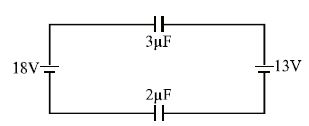
- 3Two batteries and two condensers are connected as shown in the figure. The charge on $2\,\mu F$ capacitor is.....$\mu F$View Solution
- 4A parallel plate capacitor whose capacitance $C$ is $14\, pF$ is charged by a battery to a potential difference $V =12\, V$ between its plates. The charging battery is now disconnected and a porcelin plate with $k =7$ is inserted between the plates, then the plate would oscillate back and forth between the plates with a constant mechanical energy of $..........pJ$. (Assume no friction)View Solution
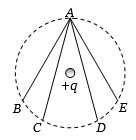
- 5In the electric field of a point charge $q$, a certain charge is carried from point $A$ to $B$, $C$, $D$ and $E$. Then the work doneView Solution
- 6An arc of radius $r$ carries charge. The linear density of charge is $\lambda$ and the arc subtends a angle $\frac{\pi }{3}$ at the centre. What is electric potential at the centreView Solution
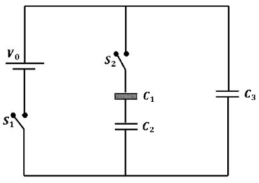
- 7Three identical capacitors $\mathrm{C}_1, \mathrm{C}_2$ and $\mathrm{C}_3$ have a capacitance of $1.0 \mu \mathrm{F}$ each and they are uncharged initially. They are connected in a circuit as shown in the figure and $\mathrm{C}_1$ is then filled completely with a dielectric material of relative permittivity $\varepsilon_{\mathrm{r}}$. The cell electromotive force (emf) $V_0=8 \mathrm{~V}$. First the switch $S_1$ is closed while the switch $S_2$ is kept open. When the capacitor $C_3$ is fully charged, $S_1$ is opened and $S_2$ is closed simultaneously. When all the capacitors reach equilibrium, the charge on $\mathrm{C}_3$ is found to be $5 \mu \mathrm{C}$. The value of $\varepsilon_{\mathrm{r}}=$. . . .View Solution
(image)
- 8For changing the capacitance of a given parallel plate capacitor, a dielectric material of dielectric constant $K$ is used, which has the same area as the plates of the capacitor. The thickness of the dielectric slab is $\frac{3}{4} d$, where $'d'$ is the separation between the plates of parallel plate capacitor. The new capacitance $(C')$ in terms of original capacitance $\left( C _{0}\right)$ is given by the following relationView Solution
- 9There is a uniformly charged non conducting solid sphere made of material of dielectric constant one. If electric potential at infinity be zero, then the potential at its surface is $V$. If we take electric potential at its surface to be zero, then the potential at the centre will beView Solution
- 10A pellet carrying charge of $0.5\, coulombs$ is accelerated through a potential of $2,000\, volts$. It attains a kinetic energy equal toView Solution