A parallel plate capacitor of capacitance $5\,\mu F$ and plate separation $6\, cm$ is connected to a $1\, V$ battery and charged. A dielectric of dielectric constant $4$ and thickness $4\, cm$ is introduced between the plates of the capacitor. The additional charge that flows into the capacitor from the battery is........$\mu C$
Medium
Download our app for free and get started
Charge on capacitor plates without the dielectric is
$\mathrm{Q}=\mathrm{CV}=\left(5 \times 10^{-6} \mathrm{\,F}\right) \times 1 \mathrm{\,V}=5 \times 10^{-6} \mathrm{\,C}=5\, \mu \mathrm{C}$
The capacitance after the dielectric is introduced is
$\mathrm{C}^{\prime}=\frac{\varepsilon_{0} \mathrm{A}}{\mathrm{d}-\left(\mathrm{t}-\frac{\mathrm{t}}{\mathrm{K}}\right)}=\frac{\varepsilon_{0} \mathrm{A} / \mathrm{d}}{1-\left(\frac{\mathrm{t}-\frac{\mathrm{t}}{\mathrm{K}}}{\mathrm{d}}\right)}$
$=\frac{\mathrm{C}}{1-\left(\frac{\mathrm{t}-\frac{\mathrm{t}}{\mathrm{K}}}{\mathrm{d}}\right)}=\frac{5\, \mu \mathrm{F}}{1-\left(\frac{4 \mathrm{\,cm}-\frac{4 \mathrm{\,cm}}{4}}{6 \mathrm{\,cm}}\right)}$
$=\frac{5\, \mu F}{1-\left(\frac{4-1}{6}\right)}=10\, \mu F$
$\therefore $ Charge on capacitor plates now will be
$\mathrm{Q}^{\prime}=\mathrm{C}^{\prime} \mathrm{V}=10 \mu \mathrm{F} \times 1 \mathrm{V}=10\, \mu \mathrm{C}$
Additional charge transferred
$=\mathrm{Q}^{\prime}-\mathrm{Q}=10 \mu \mathrm{C}-5 \mu \mathrm{C}=5\, \mu \mathrm{C}$

Download our appand get started for free
Experience the future of education. Simply download our apps or reach out to us for more information. Let's shape the future of learning together!No signup needed.*
Similar Questions
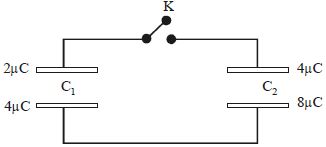
- 1Assertion : Charges are given to plates of two plane parallel plate capacitors $C_1$ and $C_2$ (such that $C_2 = 2C_1$ ) as shown in figure. Then the key $K$ is pressed to complete the circuit. Finally the net charge on upper plate and net charge the circuit. Finally the net charge on upper plate and net charge on lower plate of capacitor $C_1$ is positive.View Solution
Reason : In a parallel plate capacitor both plates always carry equal and opposite charge.
- 2Two identical capacitors, have the same capacitance $C$. One of them is charged to potential ${V_1}$ and the other to ${V_2}$. The negative ends of the capacitors are connected together. When the positive ends are also connected, the decrease in energy of the combined system isView Solution
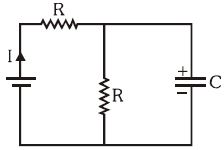
- 3In the given figure initially the capacitor is uncharged. Ratio of current at $t = 0$ & $t = \infty$ will beView Solution
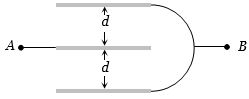
- 4Three plates of common surface area $A$ are connected as shown. The effective capacitance will beView Solution
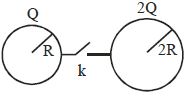
- 5Two spheres of radius $R$ and $2R$ having charge $Q$ and $2Q$ respectively are placed far away from each other. How much charge will flow when key $'k'$ is pressed ?View Solution
- 6In a uniform electric field, a cube of side $1\ cm$ is placed. The total energy stored in the cube is $8.85\ \mu J.$ The electric field is parallel to four of the faces of the cube. The electric flux through any one of the remaining two faces is.View Solution
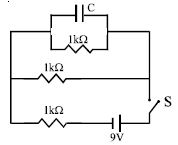
- 7A capacitor $C = 100$ $ \mu F$ is connected to three resistor each of resistance $1$ $k\Omega$ and a battery of $emf$ $9\,V$. The switch $S$ has been closed for long time so as to charge the capacitor. When switch $S$ is opened, the capacitor discharges with time constant......$ms$View Solution
- 8The electric potential $V$ is given as a function of distance $x$ (metre) by $V = (5{x^2} + 10x - 9)\,volt$. Value of electric field at $x = 1$ is......$V/m$View Solution
- 9$0.2\, F$ capacitor is charged to $600\, V$ by a battery. On removing the battery. It is connected with another parallel plate condenser of $1\, F$. The potential decreases to....$V$View Solution
- 10Ten electrons are equally spaced and fixed around a circle of radius $R$. Relative to $V = 0$ at infinity, the electrostatic potential $V$ and the electric field $E$ at the centre $C$ areView Solution