Question
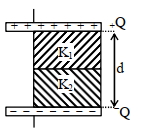
A parallel - plate capacitor with plate area $A$ has separation $d$ between the plates. Two dielectric slabs of dielectric constant ${K}_{1}$ and ${K}_{2}$ of same area $\frac A2$ and thickness $\frac d2$ are inserted in the space between the plates. The capacitance of the capacitor will be given by :
Answer

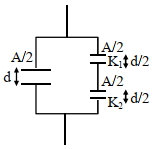
$C_{eq}=\frac{\frac{A}{2} \varepsilon_{0}}{d}+\frac{A \varepsilon_{0}}{d} \frac{K_{1} K_{2}}{K_{1}+K_{2}}$

$=\frac{A \varepsilon_{0}}{d}\left(\frac{1}{2}+\frac{K_{1} K_{2}}{K_{1}+K_{2}}\right)$

Need a full question paper?

Generate a complete, print-ready paper with questions like this in minutes — across 16+ boards, with answer keys.

Start Generating Free

Similar questions

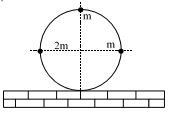
$A$ ring of mass $m$ and radius $R$ has three particles attached to the ring as shown in the figure. The centre of the ring has a speed $v_0$. The kinetic energy of the system is: (Slipping is absent)
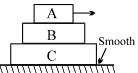
Three blocks $A, B$ and $C$ are kept as shown in the figure. The coefficient of friction between $A$ and $B$ is $0.2$, $B$ and $C$ is $0.1$ , $C$ and ground is $0.0.$ The mass of $A, B$ and $C$ are $3\, kg, 2\, kg$ and $1\, kg$ respectively. $A$ is given a horizontal velocity $10\, m/s. A, B$ and $C$ always remain in contact i.e. lies as in figure. The total work done by friction will be ........ $J$
Surface tension of a soap bubble is $2.0 \times 10^{-2}\; Nm ^{-1}$. Work done to increase the radius of soap bubble from $3.5\; cm$ to $7\; cm$ will be $.........\times 10^{-4}\,J$ [Take $\pi=\frac{22}{7}$ ]
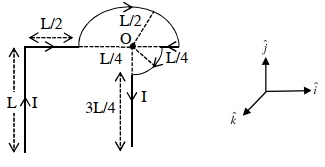
Which one of the following options represents the magnetic field $\vec{B}$ at $O$ due to the current flowing in the given wire segments lying on the $x y$ plane?
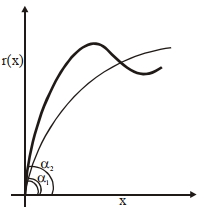
A projectile is launched from the origin in the $xy$ plane ( $x$ is the horizontal and $y$ is the vertically up direction) making an angle $\alpha$ from the $x$-axis. If its distance. $r =\sqrt{ x ^2+ y ^2}$ from the origin is plotted against $x$, the resulting curves show different behaviours for launch angles $\alpha_1$ and $\alpha_2$ as shown in the figure below. For $\alpha_1, r ( x )$ keeps increasing with $x$ while for $\alpha_2$, $r(x)$ increases and reaches a maximum, then decreases and goes through a minimum before increasing again. The switch between these two cases takes place at an angle $\alpha_c\left(\alpha_1 < \alpha_c < \alpha_2\right)$. The value of $\alpha_c$ is [ignore where $v_0$ is the initial speed of the projectile and $g$ is the acceleration due to gravity]
In the following figure, two insulating sheets with thermal resistances $R$ and $3R$ as shown in figure. The temperature $\theta$ is ...... $^oC$
In a steady state of thermal conduction, temperature of the ends $A$ and $B$ of a $20\, cm$ long rod are ${100^o}C$ and ${0^o}C$ respectively. What will be the temperature of the rod at a point at a distance of $6$ cm from the end $A$ of the rod....... $^oC$
A ray of light is incidenting normally on a plane mirror. The angle of reflection will be......$^o$
A block of mass $m$ slides down the plane inclined at angle $30^{\circ}$ with an acceleration $\frac{ g }{4}$. The value of coefficient of kinetic friction will be :
Spherical balls of radius $ 'r'$  are falling in a viscous fluid of viscosity '$\eta$' with a velocity $ 'v'. $ The retarding viscous force acting on the spherical ball is