Spherical balls of radius $ 'r'$ are falling in a viscous fluid of viscosity '$\eta$' with a velocity $ 'v'. $ The retarding viscous force acting on the spherical ball is
AIEEE 2004, Easy
Download our app for free and get started
(b)$F = 6\,\pi \eta \,rv$

Download our appand get started for free
Experience the future of education. Simply download our apps or reach out to us for more information. Let's shape the future of learning together!No signup needed.*
Similar Questions
- 1Small water droplets of radius $0.01 \mathrm{~mm}$ are formed in the upper atmosphere and falling with a terminal velocity of $10 \mathrm{~cm} / \mathrm{s}$. Due to condensation, if $8 \mathrm{such}$ droplets are coalesced and formed a larger drop, the new terminal velocity will be ........... $\mathrm{cm} / \mathrm{s}$.View Solution
- 2A cylindrical tank has a hole of $1 cm^2$ in its bottom. If the water is allowed to flow into the tank from a tube above it at the rate of $70 cm^3/sec$. then the maximum height up to which water can rise in the tank is .......... $cm$View Solution
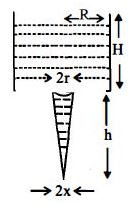
- 3Consider a water jar of radius $R$ that has water filled up to height $H$ and is kept on a stand of height $h$ (see figure) . Through a hole of radius $r$ $(r << R)$ at its bottom, the water leaks out and the stream of water coming down towards the ground has a shape like a funnel as shown in the figure. If the radius of the cross-section of water stream when it hits the ground is $x.$ ThenView Solution
- 4View SolutionSelect wrong statement about pressure ..........
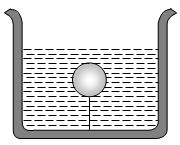
- 5A solid sphere of density $\eta$ $( > 1)$ times lighter than water is suspended in a water tank by a string tied to its base as shown in fig. If the mass of the sphere is m then the tension in the string is given byView Solution
- 6A cubical block of steel of each side equal to $l$ is floating on mercury in a vessel. The densities of steel and mercury ar $\rho _s$ and $\rho _m$ . The height of the block above the mercury level is given byView Solution
- 7Two identical cylindrical vessels with their bases at same level, each contains a liquid of density $d$ . The height of the liquid in one vessel is $ h_1$ and that in the other vessel is $h_2$ . The area of either base is $A$ . The work done by gravity in equalizing the levels when the two vessels are connected isView Solution
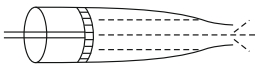
- 8Figure below shows a liquid being pushed out of the tube by a piston having area of cross section $2.0\,cm ^2$. The area of cross section at the outlet is $10\,mm ^2$. If the piston is pushed at a speed of $4\,cm s ^{-1}$, the speed of outgoing fluidis $.........\,cm s ^{-1}$.View Solution
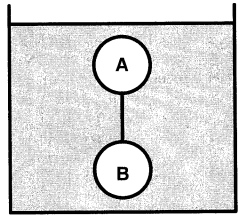
- 9Two solid spheres $A$ and $B$ of equal volumes but of different densities $d_A$ and $d_B$ are connected by a string. They are fully immersed in a fluid of density $d_F$. They get arranged into an equilibrium state as shown in the figure with a tension in the string. The arrangement is possible only ifView Solution
$(A)$ $d_Ad_F$ $(B)$ $d_B > d_F$ $(C)$ $d_A>d_F$ $(D)$ $d_A+d_B=2 d_F$
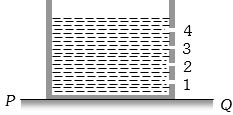
- 10A cylindrical vessel of $90 cm$ height is kept filled upto the brim. It has four holes $ 1, 2, 3, 4$ which are respectively at heights of $20 cm, 30 cm, 45 cm $ and $50 cm$ from the horizontal floor $PQ.$ The water falling at the maximum horizontal distance from the vessel comes fromView Solution