Question
A parallel-plate capacitor with the plate area 100cm2 and the separation between the plates 1.0cm is connected across a battery of emf 24 volts. Find the force of attraction between the plates.

Answer

A = 100cm2 = 10-2m2
d = 1cm = 10-2m
V = 24V0
$\therefore$ The capacitance $\text{C}=\frac{\in_0\text{A}}{\text{d}}=\frac{8.85\times10^{-12}\times10^{-2}}{10^{-2}}=8.85\times10^{-12}$
$\therefore$ The energy stored $\text{C}_1=\Big(\frac{1}{2}\Big)\text{CV}^2$
$=\Big(\frac{1}{2}\Big)\times10^{-12}\times(24)^2$
$=2548.8\times10^{-12}$
$\therefore$ The forced attraction between the plates $=\frac{\text{C}_1}{\text{d}}=\frac{2548.8\times10^{-12}}{10^{-2}}=2.54\times10^{-7}\text{N.}$

Need a full question paper?

Generate a complete, print-ready paper with questions like this in minutes — across 16+ boards, with answer keys.
Start Generating Free

Similar questions

A charged particle oscillates about its mean equilibrium position with a frequency of 109 Hz. What is the frequency of the electromagnetic waves produced by the oscillator?
What do you understand by self-induction?Obtain an expression for self-induction of a solenoid.###Define self-induction. Obtain an expression for self-induction of a solenoid of N turns, length $l$ and area of cross-section A.
Consider a 20W bulb emitting light of wavelength $5000\mathring{\text{A}}$ and shining on a metal surface kept at a distance 2m. Assume that the metal surface has work function of 2eV and that each atom on the metal surface can be treated as a circular disk of radius $1.5\mathring{\text{A}}$.
  1. Estimate no. of photons emitted by the bulb per second. [Assume no other losses]
  2. Will there be photoelectric emission?
  3. How much time would be required by the atomc disk to receive energy equal to work function (2eV)?
  4. How many photons would atomic disk receive within time duration calculated in (iii) above?
  5. Can you explain how photoelectric effect was observed instantaneously?
Hint: Time calculated in part (iii) is from classical consideration and you may further take the target of surface area say 1cm2 and estimate what would happen?
Two identical balls, each having a charge of 2.00 × 10-7C and a mass of 100g, are suspended from a common point by two insulating strings each 50cm long. The balls are held at a separation 5.0cm apart and then released. Find,
  1. The electric force on one of the charged balls.
  2. The components of the resultant force on it along and perpendicular to the string.
  3. The tension in the string.
  4. The acceleration of one of the balls. Answers are to be obtained only for the instant just after the release.
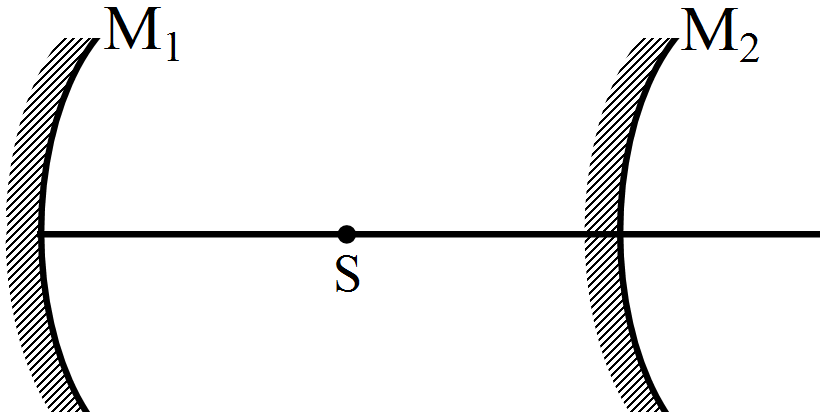
A converging mirror M1, a point source S and a diverging mirror M2 are arranged as shown in figure. The source is placed at a distance of 30cm from M1. The focal length of each of the mirrors is 20cm. Consider only the images formed by a maximum of two reflections. It is found that one image is formed on the source itself.
  1. Find the distance between the two mirrors.
  2. Find the location of the image formed by the single reflection from M2.

On the basis of band theory, differentiate between conductors, insulators and conductors.
Explain AC generator by drawing a labelled diagram. Obtain an expression for instantaneous magnitude of induced electromotive force.
Write the upper and lower limits of interference in terms of path difference.
Consider the situation of the previous problem:
  1. Find the tension in the string in equilibrium.
  2. Suppose the ball is slightly pushed aside and released. Find the time period of the small oscillations.
With the help of a ray diagram, show the formation of image of a point object due to refraction of light at a spherical surface separating two media of refractive indices n1 and n2 (n2 > n1) respectively. Using this diagram, derive the relation.
$\frac{\text{n}_2}{\text{v}}-\frac{\text{n}_1}{\text{u}}=\frac{\text{n}_1-\text{n}_2}{\text{R}}$
Write the sign conventions used. What happens to the focal length of convex lens when it is immersed in water?