A particle $A$ has charge $ + q$ and a particle $B$ has charge $ + \,4q$ with each of them having the same mass $m$. When allowed to fall from rest through the same electric potential difference, the ratio of their speed $\frac{{{v_A}}}{{{v_B}}}$ will become
Easy


Download our appand get started for free
Experience the future of education. Simply download our apps or reach out to us for more information. Let's shape the future of learning together!No signup needed.*
Similar Questions
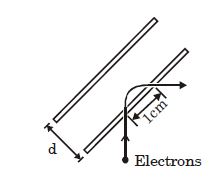
- 1A problem of practical interest is to make a beam of electrons turn at $90^o$ corner. This can be done with the electric field present between the parallel plates as shown in the figure. An electron with kinetic energy $8.0 × 10^{-17}\ J$ enters through a small hole in the bottom plate. The strength of electric field that is needed if the electron is to emerge from an exit hole $1.0\ cm$ away from the entrance hole, traveling at right angles to its original direction is $y × 10^5\ N/C$ . The value of $y$ isView Solution
- 2The capacity of a condenser in which a dielectric of dielectric constant $5$ has been used, is $C$. If the dielectric is replaced by another with dielectric constant $20$, the capacity will becomeView Solution
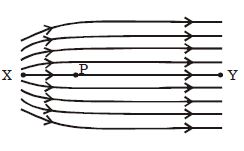
- 3The diagram below shows electric field lines in a region of space. Which of the following diagrams best shows the variation with distance $d$ of the potential $V$ along the line $XY$ as we move from $X$ to $Y$ ?View Solution
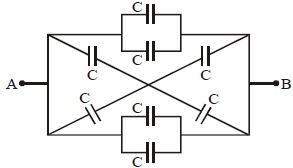
- 4Eight capacitors each of capacitance of $C$ are connected as shown in the figure. The effective capacitance between $A$ and $B$ isView Solution
- 5Three capacitors each of capacity $4\,\mu \,F$ are to be connected in such a way that the effective capacitance is $6\,\mu \,F$. This can be done byView Solution
- 6Capacitance (in $F$) of a spherical conductor with radius $1\, m$ isView Solution
- 7Two capacitors $C_1$ and $C_2$ are charged to $120\ V$ and $200\ V$ respectively. It is found that connecting them together the potential on each one can be made zero. ThenView Solution
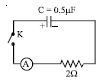
- 8A charged capacitor is allowed to discharge through a resistor by closing the key at the instant $t =0$. At the instant $t = (ln \,4) $ $\mu s$, the reading of the ammeter falls half the initial value. The resistance of the ammeter is equal toView Solution
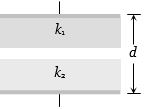
- 9Two dielectric slabs of constant ${K_1}$ and ${K_2}$ have been filled in between the plates of a capacitor as shown below. What will be the capacitance of the capacitorView Solution
- 10Two capacitors of capacitances $C$ and $2\, C$ are charged to potential differences $V$ and $2\, V$, respectively. These are then connected in parallel in such a manner that the positive terminal of one is connected to the negative terminal of the other. The final energy of this configuration is$.....CV^2$View Solution