A particle $A$ has charge $+q$ and particle $B$ has charge $+4 q$ with each of them having the same mass $m$. When allowed to fall from rest through the same electric potential difference, the ratio of their speeds $\frac{V_A}{V_B}$ will become
Easy
Download our app for free and get started
(a)
$q V=\frac{1}{2} m V_A^2 \quad V_B=\sqrt{\frac{8 q V}{m}}$
$V_A=\sqrt{\frac{2 q V}{m}}$
$\frac{V_A}{V_B}=\frac{1}{2}$

Download our appand get started for free
Experience the future of education. Simply download our apps or reach out to us for more information. Let's shape the future of learning together!No signup needed.*
Similar Questions
- 1An infinite nonconducting sheet of charge has a surface charge density of $10^{-7}\ C/m^2$. The separation between two equipotential surfaces near the sheet whose potential differ by $ 5\,V$ isView Solution
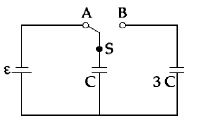
- 2In the figure shown, after the switch $‘S’$ is turned from position $‘A’$ to position $‘B’$, the energy dissipated in the circuit in terms of capacitance $‘C’$ and total charge $‘Q’$ isView Solution
- 3A spherical condenser has inner and outer spheres of radii $a$ and $b$ respectively. The space between the two is filled with air. The difference between the capacities of two condensers formed when outer sphere is earthed and when inner sphere is earthed will beView Solution
- 4A hollow metal sphere of radius $5\, cm$ is charged so that the potential on its surface is $10\, V$. The potential at the centre of the sphere isView Solution
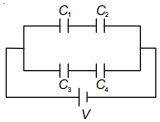
- 5Find the charge on capacitor $C_3$View Solution
Given, that $C_1=C_2=C$ and $C_3=C_4=3 C$.
- 6A series combination of $n_1$ capacitors, each of value $C_1$ is charged by a source of potential difference $4\, V.$ When another parallel combination of $n_2$ capacitors, each of value $C_2,$ is charged by a source of potential difference $V$, it has the same (total) energy stored in it, as the first combination has. The value of $C_2,$ in terms of $C_1$ is thenView Solution
- 7Two metallic spheres of radii $1\,\, cm$ and $3\,\, cm$ are given, charges of $-1$$ \times {10^{ - 2}}$ $C$ and $5$$ \times {10^{ - 2}}\,C$ respectively. If these are connected by a conducting wire, the final charge on the bigger sphere isView Solution
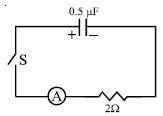
- 8A charged capacitor is allowed to discharge through a resistance $2\,\Omega $ by closing the switch $S $ at the instant $t = 0$. At time $t = ln$ $2$ $\mu s$, the reading of the ammeter falls half of its initial value. The resistance of the ammeter equal toView Solution
- 9A hollow metallic sphere of radius $R$ is given a charge $Q$. Then the potential at the centre isView Solution
- 10The capacitance $(C)$ for an isolated conducting sphere of radius $(a)$ is given by $4\pi \varepsilon_0a$. If the sphere is enclosed with an earthed concentric sphere. The ratio of the radii of the spheres $\frac{n}{{(n - 1)}}$ being then the capacitance of such a sphere will be increased by a factorView Solution