A particle executes $S.H.M.$ with a period of $6$ second and amplitude of $3\, cm$. Its maximum speed in $cm/sec$ is
AIIMS 1982, Easy


Download our appand get started for free
Experience the future of education. Simply download our apps or reach out to us for more information. Let's shape the future of learning together!No signup needed.*
Similar Questions
- 1Two simple pendulums of length $1\, m$ and $4\, m$ respectively are both given small displacement in the same direction at the same instant. They will be again in phase after the shorter pendulum has completed number of oscillations equal toView Solution
- 2A particle of mass m is under the influence of a force $F$ which varies with the displacement $x$ according to the relation $F = - kx + {F_0}$ in which $k$ and ${F_0}$ are constants. The particle when disturbed will oscillateView Solution
- 3The period of a simple pendulum measured inside a stationary lift is found to be $T$. If the lift starts accelerating upwards with acceleration of $g/3,$ then the time period of the pendulum isView Solution
- 4Time period of a particle executing $SHM$ is $8\, sec.$ At $t = 0$ it is at the mean position. The ratio of the distance covered by the particle in the $1^{st}$ second to the $2^{nd}$ second is :View Solution
- 5A pendulum is suspended in a lift and its period of oscillation when the lift is stationary is $T_0$. What must be the acceleration of the lift for the period of oscillation of the pendulum to be $T_0/2$ ?View Solution
- 6View SolutionFor the system given below, find the angular frequency of oscillation ?
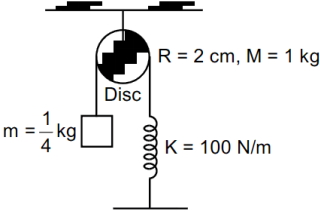
- 7A cuboidal piece of wood has dimensions $a, b$ and $c$. Its relative density is $d$. It is floating in a large body of water such that side a is vertical. It is pushed down a bit and released. The time period of $SHM$ executed by it is :View Solution
- 8A particle performing $SHM$ is found at its equilibrium at $t = 1\,sec$. and it is found to have a speed of $0.25\,m/s$ at $t = 2\,sec$. If the period of oscillation is $6\,sec$. Calculate amplitude of oscillationView Solution
- 9Out of the following functions representing motion of a particle which represents $SHM$View Solution
$(A)\;y= sin\omega t-cos\omega t$
$(B)\;y=sin^3\omega t$
$(C)\;y=5cos\left( {\frac{{3\pi }}{4} - 3\omega t} \right)$
$(D)\;y=1+\omega t+{\omega ^2}{t^2}$
- 10The bob of a simple pendulum of mass m and total energy $E$ will have maximum linear momentum equal toView Solution