A particle executes simple harmonic motion with an amplitude of $4 \mathrm{~cm}$. At the mean position, velocity of the particle is $10 \mathrm{~cm} / \mathrm{s}$. The distance of the particle from the mean position when its speed becomes $5 \mathrm{~cm} / \mathrm{s}$ is $\sqrt{\alpha} \mathrm{cm}$, where $\alpha=$____________.
JEE MAIN 2024, Diffcult
Download our app for free and get started
$ \mathrm{V}_{\mathrm{at} \text { mann position }}=\mathrm{A} \omega \Rightarrow 10=4 \omega $
$ \omega=\frac{5}{2} $
$ \mathrm{~V}=\omega \sqrt{\mathrm{A}^2-\mathrm{x}^2} $
$ 5=\frac{5}{2} \sqrt{4^2-\mathrm{x}^2} \Rightarrow \mathrm{x}^2=16-4 $
$ \mathrm{x}=\sqrt{12} \mathrm{~cm}$

Download our appand get started for free
Experience the future of education. Simply download our apps or reach out to us for more information. Let's shape the future of learning together!No signup needed.*
Similar Questions
- 1The period of a simple pendulum measured inside a stationary lift is found to be $T$. If the lift starts accelerating upwards with acceleration of $g/3,$ then the time period of the pendulum isView Solution
- 2A spring whose unstretched length is $\ell $ has a force constant $k$. The spring is cut into two pieces of unstretched lengths $\ell_1$ and $\ell_2$ where, $\ell_1 = n\ell_2$ and $n$ is an integer. The ratio $k_1/k_2$ of the corresponding force constants, $k_1$ and $k_2$ will beView Solution
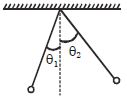
- 3Two masses, both equal to $100\, g$, are suspended at the ends of identical light strings of length $\lambda = 1.0\, m$, attached to the same point on the ceiling (see figure). At time $t = 0$, they are simultaneously released from rest, one at angle $\theta_1 = 1^o$, the other at angle $\theta_2 = 2^o$ from the vertical. The masses will collideView Solution
- 4The displacement of a particle moving in $S.H.M.$ at any instant is given by $y = a\sin \omega t$. The acceleration after time $t = \frac{T}{4}$ is (where $T$ is the time period)View Solution
- 5For a simple pendulum the graph between $L$ and $T$ will be.View Solution
- 6A particle executes $S.H.M.$ and its position varies with time as $x=A$ sin $\omega t$. Its average speed during its motion from mean position to mid-point of mean and extreme position isView Solution
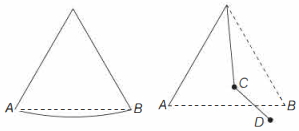
- 7A simple pendulum oscillates freely between points $A$ and $B$. We now put a peg (nail) at the point $C$ as shown in above figure. As the pendulum moves from $A$ to the right, the string will bend at $C$ and the pendulum will go to its extreme point $D$. Ignoring friction, the point $D$View Solution
- 8The displacement of a particle executing SHM is given by $x=10 \sin \left(\omega t+\frac{\pi}{3}\right) \mathrm{m}$. The time period of motion is $3.14 \mathrm{~s}$. The velocity of the particle at $\mathrm{t}=0$is_________. $\mathrm{m} / \mathrm{s}$.View Solution
- 9A simple pendulum performs simple harmonic motion about $X = 0$ with an amplitude $A$ and time period $T$. The speed of the pendulum at $X = \frac{A}{2}$ will beView Solution
- 10A body is executing simple harmonic motion with an angular frequency $2\,rad/s$. The velocity of the body at $20\, mm$ displacement, when the amplitude of motion is $60\, mm$, is ...... $mm/s$View Solution