MCQ
A particle executes simple harmonic motion with an amplitude of $4 \,cm$. At the mean position the velocity of the particle is $10\, cm/s$. The distance of the particle from the mean position when its speed becomes $5 \,cm/s$ is
  • A
    $\sqrt 3 \,cm$
  • B
    $\sqrt 5 \,cm$
  • $2(\sqrt 3 )\,cm$
  • D
    $2(\sqrt 5 )\,cm$

Answer

Correct option: C.
$2(\sqrt 3 )\,cm$
c
(c) ${v_{\max }} = a\omega $

==> $\omega = \frac{{{v_{\max }}}}{a} = \frac{{10}}{4}$ 

Now, $v = \omega \sqrt {{a^2} - {y^2}} $

==> ${v^2} = {\omega ^2}({a^2} - {y^2})$

==> ${y^2} = {a^2} - \frac{{{v^2}}}{{{\omega ^2}}}$ 

$y = \sqrt{{a^2} - \frac{{{v^2}}}{{{\omega ^2}}}}$

$= \sqrt{{4^2} - \frac{5^2}{{({\frac{10}{4}})^2}}}$

$ = 2\sqrt 3 \,cm$

Need a full question paper?

Generate a complete, print-ready paper with questions like this in minutes — across 16+ boards, with answer keys.

Start Generating Free

Similar questions

A gas expands adiabatically at constant pressure such that its temperature $T \propto \frac{1}{{\sqrt V }}$, the value of ${C_P}/{C_V}$ of gas is
A driver takes $0.20s$ to apply the brakes after he sees a need for it. This is called the reaction time of the driver. If he is driving a car at a speed of $54km/ h$ and the brakes causes a deceleration of $6.0 m/ s^2$, find the distance traveled by the car after he sees the need to put the brakes on.
A body is revolving with a uniform speed $v$ in a circle of radius $r$. The tangential acceleration is
Three liquids of densities $\rho _1,\rho _2$ and $\rho _3$ (with $\rho _1 > \rho _2 > \rho_3),$ having the same value of surface tension $T,$ rise to the same height in three identical capillaries. The angles of contact $\theta_1 \,,\theta_2$ and $\theta_3$ obey  
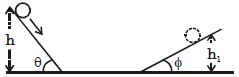
A demonstration apparatus on a table in the lab is shown in diagram. It consists of a metal track (shown as a thick solid line in the figure below) along which a perfectly spherical marble which can roll without slipping. In one run, the marble is released from rest at a height h above the table on the left section, rolls down one side and then up the other side without slipping, briefly stopping when it has reached $h_1$. Assuming the table to be horizontal and neglecting air drag as well as any energy loss due to rolling,
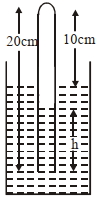
A $20 \,cm$ long tube is closed at one end. It is held vertically, and its open end is dipped in water until only half of it is outside the water surface. Consequently, water rises in it by height $h$ as shown in the figure. The value of $h$ is closest to .............. $\,m / s$ (assume that the temperature remains constant, $P _{\text {armosphere }}=10^5 \,N / m ^2$, density. of water $=10^3 \,kg / m ^3$, and acceleration due to gravity $g =10 \,m / s ^2$ )
A perfect gas at $27^\circ C$ is heated at constant pressure to $327^\circ C$. If original volume of gas at $27^\circ C$ is $V$ then volume at $327^\circ C$ is
A physical quantity $p$ is described by the relation $p\, = a^{1/2}\, b^2\, c^3\, d^{-4}$

If the relative errors in the measurement of $a, b, c$ and $d$ respectively, are $2\% , 1\%, 3\%$ and $5\%$, then the relative error in $P$ will be ........... $\%$

Which one of the following pairs of quantities and their units is a proper match
The energy spectrum of a black body exhibits a maximum around a wavelength ${\lambda _o}.$ The temperature of the black body is now changed such that the energy is maximum around a wavelength $\frac{{3{\lambda _o}}}{4}$.The power radiated by the black body will now increase by a factor of