MCQ
A particle executing simple harmonic motion has an amplitude of $6\, cm$. Its acceleration at a distance of $2 \,cm$ from the mean position is $8\,cm/{s^2}$. The maximum speed of the particle is ... $ cm/s$
  • A
    $8$
  • $12$
  • C
    $16$
  • D
    $24$

Answer

Correct option: B.
$12$
b
$A = {\omega ^2}y$

$\omega  = \sqrt {A/y}  = \sqrt {\frac{8}{2}}  = 2\,rad/sec$

Now ${v_{\max }} = a\omega  = 6 \times 2 = 12\,cm/sec$

Need a full question paper?

Generate a complete, print-ready paper with questions like this in minutes — across 16+ boards, with answer keys.

Start Generating Free

Similar questions

If there were no gravity. which of the following will not be there for a fluid?
An ice block is melting at a constant rate $\left| {\,\frac{{dm}}{{dt}}\,} \right|= \mu$ . Its initial mass is $m_0$ and it is moving with velocity on a frictionless horizontal surface. The distance travelled by it till it melts completely is :
The moment of inertia of a thin uniform rod of mass $M$ and length $L$ about an axis passing through its midpoint and perpendicular to its length is $I_0$. Its moment of inertia about an axis  passing through one of its ends and perpendicular to its length is 
A projectile is thrown at an angle $\theta$ with the horizontal and its range is $R_1$. It is then thrown at an angle $\theta$ with vertical and the range is $R_2$, then
A pendulum is swinging in an elevator. Its period will be greatest when the elevator is
A string of length $2 m$ is fixed at both ends. If this string vibrates in its fourth normal mode with a frequency of $500 Hz$ then the waves would travel on its with a velocity of ..... $m/s$
The density of a non-uniform rod of length 1m is given by $\rho(\text{x})=\alpha(1+\text{b}\text{x}^2)$ where a and b are constants and $0\leq\text{x}\leq1$ The centre of mass of the rod will be at:

  1. $\frac{3(2+\text{b})}{4(3+\text{b})}$

  2. $\frac{4(2+\text{b})}{3(3+\text{b})}$

  3. $\frac{3(3+\text{b})}{4(2+\text{b})}$

  4. $\frac{4(3+\text{b})}{3(2+\text{b})}$

A particle of mass $2\, kg$ is on a smooth horizontal table and moves in a circular path of radius $0.6\, m$. The height of the table from the ground is $0.8\, m$. If the angular speed of the particle is $12\, rad\, s^{-1}$, the magnitude of its angular momentum about a point on the ground right under the centre of the circle is ........ $kg\, m^2\,s^{-1}$
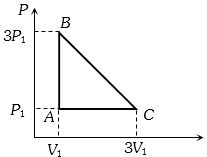
An ideal gas is taken around the cycle $ABCA$ as shown in the $P-V $ diagram. The net work done by the gas during the cycle is equal to
The function ${\sin ^2}(\omega t)$ represents