MCQ
A particle experiences a constant acceleration for $20 \,sec$ after starting from rest. If it travels a distance ${S_1}$ in the first $10\, sec$ and a distance ${S_2}$ in the next $10 \,sec$, then
  • A
    ${S_1} = {S_2}$
  • ${S_1} = {S_2}/3$
  • C
    ${S_1} = {S_2}/2$
  • D
    ${S_1} = {S_2}/4$

Answer

Correct option: B.
${S_1} = {S_2}/3$
b
(b) As $S = ut + \frac{1}{2}a{t^2}$

$\therefore {S_1} = \frac{1}{2}a{(10)^2} = 50a$ .....(i)

$As\;\;v = u + at$

$\therefore $ velocity acquired by particle in $10 \,sec$ $v = a \times 10$

For next $10\, sec$ ,

${S_2} = (10a) \times 10 + \frac{1}{2}(a) \times {(10)^2}$

${S_2} = $ $150a$ .....(ii)

From (i) and (ii)

${S_1} = {S_2}/3$

Need a full question paper?

Generate a complete, print-ready paper with questions like this in minutes — across 16+ boards, with answer keys.

Start Generating Free

Similar questions

If a propagating wave meets a boundary which is not completely rigid or is an interface between two different elastic media, then which of the statements is/ are correct?
If P, Q, R are physical quantities, having different dimensions, which of the following combinations can never be a meaningful quantity?

  1. $\frac{(\text{P}-\text{Q})}{\text{R}}$

  2. $\text{PQ}-\text{R}$

  3. $\frac{\text{PQ}}{\text{R}}$

  4. $\frac{(\text{PR}-\text{Q}^2)}{\text{R}}$

  5. $\frac{(\text{R}+\text{Q})}{\text{P}}$

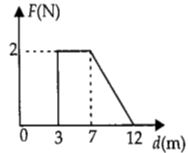
Force $F$ on a particle moving in a straight line varies with distance $d$ as shown in figure.The work done on the particle during its displacement of $12\, m$ is ................. $\mathrm{J}$
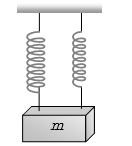
A mass $m$ is suspended separately by two different springs of spring constant $K_1$ and $K_2$ gives the time-period ${t_1}$ and ${t_2}$ respectively. If same mass $m$ is connected by both springs as shown in figure then time-period $t$ is given by the relation
A simple pendulum consisting of a light inextensible string of length $\ell$ attached to a heavy small bob of mass $m$ is at rest. The bob is imparted a horizontal impulsive force which gives it a speed of $\sqrt{4 g \ell}$. The speed of the bob at its highest point is ( $g$ is the accelaration due to gravity)
Two soap bubbles of radii $2 \,cm$ and $4 \,cm$ join to form a double bubble in air, then radius of curvature of interface is .......... $cm$
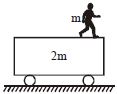
A man is standing on a cart of mass double the mass of man. Initially cart is at rest. Now man jumps horizontally with relative velocity $'u'$ with respect to cart. Then work done by internal forces of the man during the process of jumping will be :
The height of any point $P$ above the surface of earth is equal to diameter of earth. The value of acceleration due to gravity at point $P$ will be : (Given $g=$ acceleration due to gravity at the surface of earth)
A block is placed on a rough horizontal plane. A time dependent horizontal force $F = Kt$ acts on the block. Here $K$ is a positive constant. Acceleration-time graph of the block is
A small block of mass m is kept on a rough inclined surface of inclination $\theta$ fixed in an elevator. The elevator goes up with a uniform velocity v and the block does not slide on the wedge. The work done by the force of friction on the block in time t will be:

  1. zero

  2. $\text{mgvt}\cos^2\theta$

  3. $\text{mgvt}\sin^2\theta$

  4. $\text{mgvt}\sin2\theta$