Question
A particle falling vertically from a height hits a plane surface inclined to horizontal at an angle $\theta$ with speed $\text{v}_0$ and rebounds elastically. Find the distance along the plane where if will hit second time.
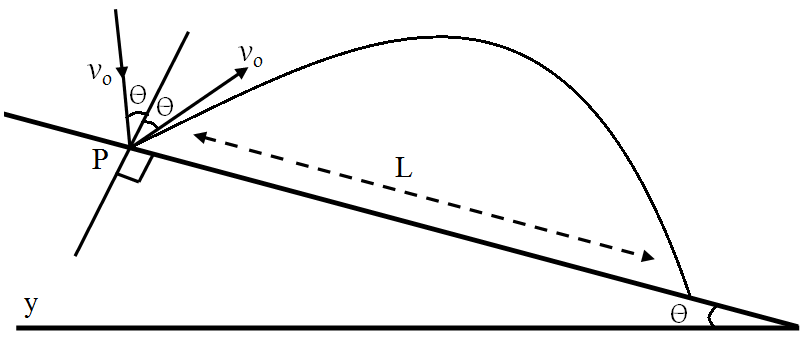
(Hint:
  1. After rebound, particle still has speed Vo to start.
  2. Work out angle particle speed has with horizontal after it rebounds.
  3. Rest is similar to if particle is projected up the incline.
Answer

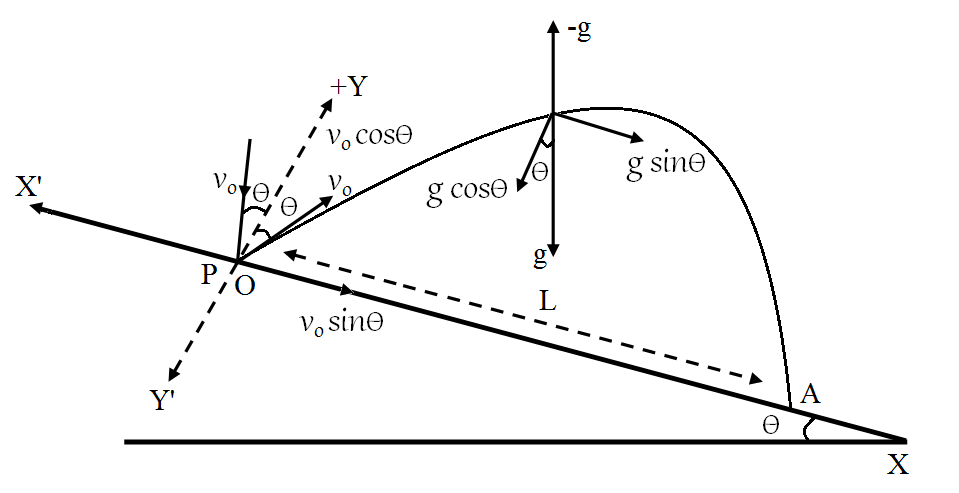
Particle rebounces from P so it will be an elastic collision. As it strikes plane inclined at $\text{v}_0$ speed so speed of particle after rebounces will be $\text{v}_0$ Again consider the new axia X'OX and YOY' axis at P as origin 'O'. The componenets of g and $\text{v}_0$ in new OX and OY axis are:
$\text{v}_\text{x}=\text{v}_0\sin\theta\text{ and v}_\text{y}=\text{v}_0\cos\theta$ $\text{g}_\text{x}=\text{g}\cos\theta,\text{g}_\text{y}=\text{g}\sin\theta$ acting vertically downwords Consider the motion of particle from O to A in new YOY' axis. $\text{s}_\text{y}=\text{u}_\text{y}\text{t}+\frac{1}{2}\text{a}_\text{y}\text{t}^2$ $\text{s}_\text{y}=0\ \text{v}_\text{y}=\text{v}_0\cos\theta\ \text{a}_\text{y}=-\text{g}\sin\theta $ (upward) $\therefore\text{t=T}$ (time of flight) $0=\text{T}\Big[\text{v}_0\cos\theta-\frac{1}{2}\text{g}\text{ sin}\theta\text{ T}\Big]$ This means either $\text{T}=0\text{ or v}_0\cos\theta-\frac{\text{g}\cos\theta(\text{T})}{2}=0$T cannot be zero $\Rightarrow\text{T}=\frac{2\text{v}_0\cos\theta}{\text{g}\cos\theta}$
$\text{T}=\frac{2\text{v}_0}{\text{g}}$
Now consider the motion along OX axis. $\text{S}_\text{x}=\text{L, u}_\text{x}=\upsilon_0\sin\theta,\text{a}_\text{x}=\text{g}\sin\theta,\text{t}=\text{T}=\frac{2\upsilon_0}{\text{g}}$ $\text{S}_\text{x}=\text{u}_\text{x}\text{t}+\frac{1}{2}\text{a}_\text{x}\text{t}^2$ $\text{L}=\Big[\frac{2\text{v}_\text{0}}{\text{g}}\Big]\text{v}_0\sin\theta+\frac{1}{2}\text{g}\sin\theta\Big[\frac{2\text{v}_0}{\text{g}}\Big]^2$ $\text{L}=\frac{2\text{v}^2_0}{\text{g}}\sin\theta+\frac{1}{2}\text{g}\sin\theta.\frac{4\text{v}^2_0}{\text{g}^2}$ $=\frac{2\text{v}^2_0}{\text{g}}[\sin\theta+\sin\theta]=\frac{2\text{v}^2_0}{\text{g}}2\sin\theta$ $\Rightarrow\text{L}=\frac{4\text{v}^2_0}{\text{g}}\sin\theta.$

Need a full question paper?

Generate a complete, print-ready paper with questions like this in minutes — across 16+ boards, with answer keys.

Start Generating Free

Similar questions

Suppose that the radius of cross-section of the wire used in the previous problem is r. Find the increase in the radius of the loop if the magnetic field is switched off. Young's modulus of the material of the wire is Y.
Establish the following vector inequalities geometrically or otherwise: $|\text{a}+\text{b}|\le|\text{a}|+|\text{b}|$ When does the equality sign above apply?
Figure shows two blocks in contact sliding down an inclined surface of inclination $30°$. The friction coefficient between the block of mass $2.0kg$ and the incline is $\mu_1,$ and that between the block of mass $4.0kg$ and the incline is $\mu_2.$ Calculate the acceleration of the 2.0kg block if:
  1. $\mu_1=0.20$ and $\mu_2=0.30$
  2. $\mu_1=0.30$ and $\mu_2=0.20$ Take $\text{g}=10\text{m/s}^2.$

A copper wire of radius 0.1mm and resistance $1\text{k}\Omega$ is connected across a power supply of 20V.
(a) How many electrons are transferred per second between the supply and the wire at one end? (b) Write down the current density in the wire.
In an infinite homogeneous viscous liquid a sphere is falling. Obtain the formula for terminal velocity of the sphere.
The internal energy of a gas is given by $U=1.5 \mathrm{PV}$. It expands from $100 \mathrm{~cm}^3$ to $200 \mathrm{~cm}^3$ against a constant pressure of $1.0 \times 10^5 \mathrm{~Pa}$. Calculate the heat absorbed by the gas in the process.
An object weighing $70kg$ is kept in a lift. Find its weight as recorded by a spring balance when the lift
  1. Moves upwards with a uniform velocity of $5ms^{-1}$,
  2. Moves upwards with a uniform acceleration of $2.2ms^{-2}$
  3. Moves downwards with a uniform acceleration of $2.8ms^{-2}$ and
  4. Falls freely under gravity.
  1. Prove that the work done in stretching a wire per unit volume is $\frac{1}{2}\times\text{tension}\times\text{extension.}$
  2. Prove that the work done per unit volume in stretching a wire for every type of strain $=\frac{1}{2}\times\text{stress}\times\text{strain}.$
Two particles A and B, each carrying a charge Q, are held fixed with a separation d between them. A particle C having mass m and charge q is kept at the middle point of the line AB.
  1. If it is displaced through a distance x perpendicular to AB, what would be the electric force experienced by it.
  2. Assuming x << d, show that this force is proportional to x.
  3. Under what conditions will the particle C execute simple harmonic motion if it is released after such a small displacement?
Find the time period of the oscillations if these conditions are satisfied.
Separation of Motion of a system of particles into motion of the centre of mass and motion about the centre of mass: Show $\text{p}=\text{p}'_\text{i}+\text{m}_\text{i}\text{V}$ where $p_i$ is the momentum of the ith particle (of mass $m_i$ ) and $p′_i = m_iv′_i.$ Note: $v′_i$ is the velocity of the ith particle relative to the centre of mass. Also, prove using the definition of the centre of mass.