Separation of Motion of a system of particles into motion of the centre of mass and motion about the centre of mass: Show $\text{p}=\text{p}'_\text{i}+\text{m}_\text{i}\text{V}$ where $p_i$ is the momentum of the ith particle (of mass $m_i$ ) and $p′_i = m_iv′_i.$ Note: $v′_i$ is the velocity of the ith particle relative to the centre of mass. Also, prove using the definition of the centre of mass.
Exercise
Download our app for free and get started
Take a system of i moving particles. Mass of the $i^{th}$ particle = $m_i$ Velocity of the $i^{th}$ particle = $v_i$ Hence, momentum of the $i^{th}$ particle, $\text{p}_\text{i}=\text{m}_\text{i}\text{v}_{\text{i}}$ Velocity of the centre of mass = V The velocity of the $i^{th}$ particle with respect to the centre of mass of the system is given as, $\text{v}'_{\text{i}}=\text{v}_\text{i}-\text{V}\ ...(\text{i})$ Multiplying $m_i$ throughout equation (i), we get, $\text{m}_\text{i}\text{v}'_\text{i}=\text{m}_\text{i}\text{v}_\text{i}-\text{m}_\text{i}\text{V}$
$\text{p}'_\text{i}-\text{m}_\text{i}\text{V}$ Where, $\text{p}'_\text{i}=\text{m}_\text{i}\text{v}_\text{i}'=$ Momentum of the $i^{th}$^ particle with respect to the centre of mass of the system, $\therefore\text{ p}_\text{i}=\text{p}'_\text{i}+\text{m}_\text{i}\text{V}$ We have the relation, $\text{p}'_\text{i}=\text{m}_\text{i}\text{v}_\text{i}'$ Taking the summation of momentum of all the particles with respect to the centre of mass of the system, we get $\sum_\limits\text{i}\text{p}'_\text{i}=\sum_\limits\text{i}\text{m}_\text{i}\text{v}'_\text{i}=\sum\limits_\text{i}\frac{\text{dr}'_\text{i}}{\text{dt}}$ Where, $\text{r}'_\text{i}=$ Position vector of $i^{th}$ particle with respect to the centre of mass. $\text{v}'_\text{i}=\frac{\text{dr}'_\text{i}}{\text{dt}}$ As per the definition of the centre of mass, we have, $\sum\limits_\text{i}\text{m}_\text{i}\text{r}'_\text{i}=0$
$\therefore\ \sum\limits_\text{i}\text{m}_\text{i}\frac{\text{dr}'_\text{i}}{\text{dt}}=0$
$\sum\limits_\text{i}\text{p}'_\text{i}=0$
$\text{p}'_\text{i}-\text{m}_\text{i}\text{V}$ Where, $\text{p}'_\text{i}=\text{m}_\text{i}\text{v}_\text{i}'=$ Momentum of the $i^{th}$^ particle with respect to the centre of mass of the system, $\therefore\text{ p}_\text{i}=\text{p}'_\text{i}+\text{m}_\text{i}\text{V}$ We have the relation, $\text{p}'_\text{i}=\text{m}_\text{i}\text{v}_\text{i}'$ Taking the summation of momentum of all the particles with respect to the centre of mass of the system, we get $\sum_\limits\text{i}\text{p}'_\text{i}=\sum_\limits\text{i}\text{m}_\text{i}\text{v}'_\text{i}=\sum\limits_\text{i}\frac{\text{dr}'_\text{i}}{\text{dt}}$ Where, $\text{r}'_\text{i}=$ Position vector of $i^{th}$ particle with respect to the centre of mass. $\text{v}'_\text{i}=\frac{\text{dr}'_\text{i}}{\text{dt}}$ As per the definition of the centre of mass, we have, $\sum\limits_\text{i}\text{m}_\text{i}\text{r}'_\text{i}=0$
$\therefore\ \sum\limits_\text{i}\text{m}_\text{i}\frac{\text{dr}'_\text{i}}{\text{dt}}=0$
$\sum\limits_\text{i}\text{p}'_\text{i}=0$

Download our appand get started for free
Experience the future of education. Simply download our apps or reach out to us for more information. Let's shape the future of learning together!No signup needed.*
Similar Questions
- 1Two discs of moments of inertia $I_1$ and $I_2$ about their respective axes (normal to the disc and passing through the centre), and rotating with angular speed $\omega_1$ and $\omega_2$ are brought into contact face to face with their axes of rotation coincident.View Solution
- Does the law of conservation of angular momentum apply to the situation? why?
- Find the angular speed of the two-disc system.
- Calculate the loss in kinetic energy of the system in the process.
- Account for this loss.
- 2View SolutionA cylinder is suspended by two strings wrapped around the cylinder near each end, the free ends of the string being attached to hooks on the ceiling, such that the length of the cylinder is horizontal. From the position of rest, the cylinder is allowed to roll down as suspension strings unwind. Calculate: (i) the downward linear acceleration of the cylinder and (ii) tension in the strings. Mass of cylinder is 12kg.
- 3A uniform sphere of mass m and radius R is placed on a rough horizontal surface. The sphere is struck horizontally at a height h from the floor. Match the following:View Solution
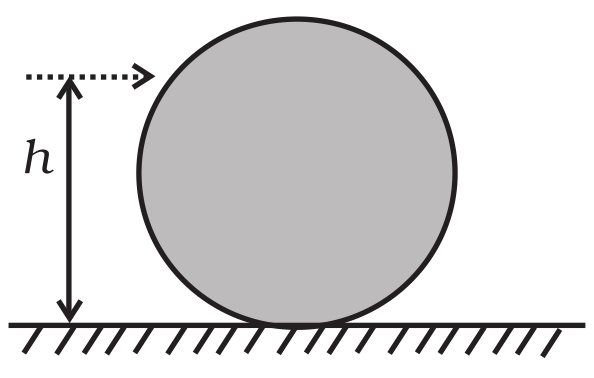
a. $\text{h}=\frac{\text{R}}{2}$ i. Sphere rolls without slipping with a constant velocity and no loss of energy. b. $\text{h}=\text{R}$ ii. Sphere spins clockwise, loses energy by friction. c. $\text{h}=\frac{3\text{R}}{2}$ iii. Sphere spins anti-clockwise, loses energy by friction. d. $\text{h}=\frac{7\text{R}}{5}$ iv. Sphere has only a translational motion, looses energy by friction. - 4View SolutionA uniform disc of radius R is put over another uniform disc of radius 2R of the same thickness and density. The peripheries of the two discs touch each other. Locate the centre of mass of the system.
- 5In the HCl molecule, the separation between the nuclei of the two atoms is about $1.27\mathring{\text{A}}\big(1\mathring{\text{A}}= 10^{-10} \text{m}\big).$ Find the approximate location of the CM of the molecule, given that a chlorine atom is about 35.5 times as massive as a hydrogen atom and nearly all the mass of an atom is concentrated in its nucleus.View Solution
- 6View SolutionA threaded rod with 12turns/ cm and diameter 1.18cm is mounted horizontally. A bar with a threaded hole to match the rod is screwed onto the rod. The bar spins at 216rev/ min. How long will it take for the bar to move 1.50cm along the rod?
- 7Find the centre of mass of a uniform $L-$shaped lamina $($a thin flat plate$)$ with dimensions as shown. The mass of the lamina is $3 \ kg.$View Solution
- 8$(n - 1)$ equal point masses each of mass m are placed at the vertices of a regular n-polygon. The vacant vertex has a position vector a with respect to the centre of the polygon. Find the position vector of centre of mass.View Solution
- 9The distance between the centres of carbon and oxygen atoms in carbon monoxide gas molecules is $=1.13\mathring{\text{A}}.$ Locate the centre of mass of the molecules relative to carbon atom.View Solution
- 10View SolutionA uniform rod of length L lies on a smooth horizontal table. A particle moving on the table strikes the rod perpendicularly at an end and stops. Find the distance travelled by the centre of the rod by the time it turns through a right angle. Show that if the mass of the rod is four times that of the particle, the collision is elastic.