Question
A particle falling vertically from a height hits a plane surface inclined to horizontal at an angle $\theta$ with speed $\text{v}_0$ and rebounds elastically. Find the distance along the plane where if will hit second time.
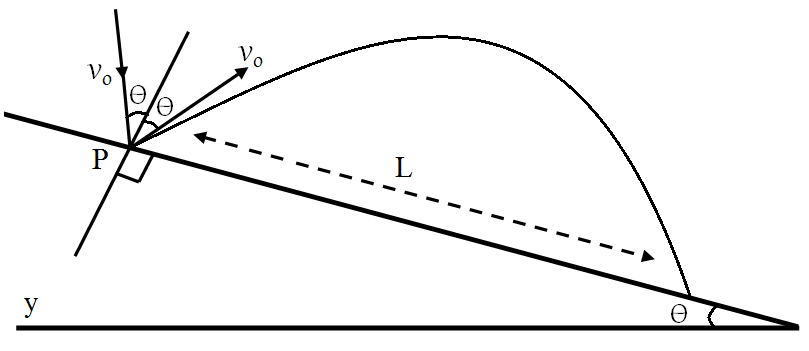
(Hint:

  1. After rebound, particle still has speed Vo to start.
  2. Work out angle particle speed has with horizontal after it rebounds.
  3. Rest is similar to if particle is projected up the incline.
Answer

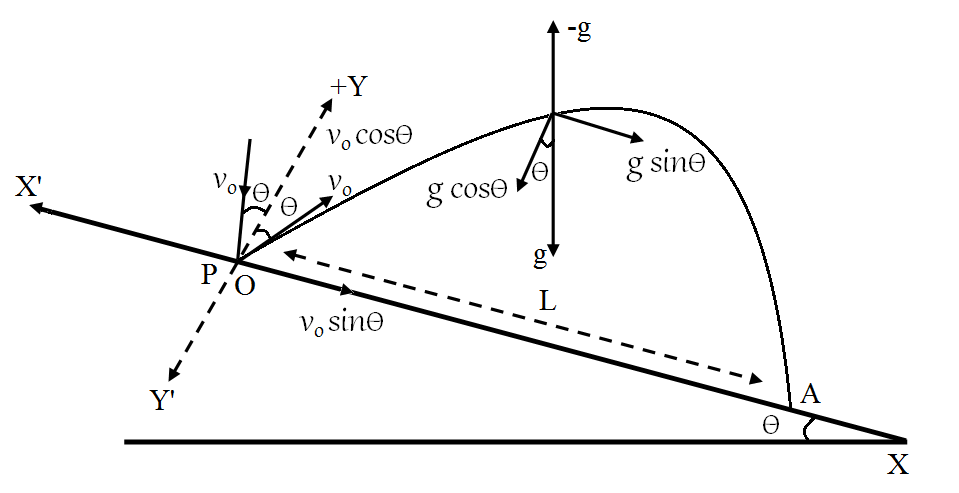
Particle rebounces from P so it will be an elastic collision. As it strikes plane inclined at  $\text{v}_0$ speed so speed of particle after rebounces will be $\text{v}_0$

Again consider the new axia X'OX and YOY' axis at P as origin 'O'. The componenets of g and $\text{v}_0$ in new OX and OY axis are:

$\text{v}_\text{x}=\text{v}_0\sin\theta\text{ and v}_\text{y}=\text{v}_0\cos\theta$

$\text{g}_\text{x}=\text{g}\cos\theta,\text{g}_\text{y}=\text{g}\sin\theta$ acting vertically downwords 

Consider the motion of particle from O to A in new YOY' axis.

$\text{s}_\text{y}=\text{u}_\text{y}\text{t}+\frac{1}{2}\text{a}_\text{y}\text{t}^2$

$\text{s}_\text{y}=0\ \text{v}_\text{y}=\text{v}_0\cos\theta\ \text{a}_\text{y}=-\text{g}\sin\theta $ (upward)

$\therefore\text{t=T}$ (time of flight)

$0=\text{T}\Big[\text{v}_0\cos\theta-\frac{1}{2}\text{g}\text{ sin}\theta\text{ T}\Big]$

This means either $\text{T}=0\text{ or v}_0\cos\theta-\frac{\text{g}\cos\theta(\text{T})}{2}=0$

T cannot be zero $\Rightarrow\text{T}=\frac{2\text{v}_0\cos\theta}{\text{g}\cos\theta}$

$\text{T}=\frac{2\text{v}_0}{\text{g}}$

Now consider the motion along OX axis.

$\text{S}_\text{x}=\text{L, u}_\text{x}=\upsilon_0\sin\theta,\text{a}_\text{x}=\text{g}\sin\theta,\text{t}=\text{T}=\frac{2\upsilon_0}{\text{g}}$

$\text{S}_\text{x}=\text{u}_\text{x}\text{t}+\frac{1}{2}\text{a}_\text{x}\text{t}^2$

$\text{L}=\Big[\frac{2\text{v}_\text{0}}{\text{g}}\Big]\text{v}_0\sin\theta+\frac{1}{2}\text{g}\sin\theta\Big[\frac{2\text{v}_0}{\text{g}}\Big]^2$

$\text{L}=\frac{2\text{v}^2_0}{\text{g}}\sin\theta+\frac{1}{2}\text{g}\sin\theta.\frac{4\text{v}^2_0}{\text{g}^2}$

$=\frac{2\text{v}^2_0}{\text{g}}[\sin\theta+\sin\theta]=\frac{2\text{v}^2_0}{\text{g}}2\sin\theta$

$\Rightarrow\text{L}=\frac{4\text{v}^2_0}{\text{g}}\sin\theta.$

Need a full question paper?

Generate a complete, print-ready paper with questions like this in minutes — across 16+ boards, with answer keys.

Start Generating Free

Similar questions

Find the time period of small oscillations of the following systems.
  1. A metre stick suspended through the 20cm mark.
  2. A ring of mass in and radius r suspended through a point on its periphery.
  3. A uniform square plate of edge a suspended through a corner.
  4. A unifrom disc of mass m and radius r suspended through a point $\frac{\text{r}}{2}$ away from the centre.
A wire stretched between two rigid supports vibrates in its fundamental mode with a frequency of 45Hz. The mass of the wire is 3.5 × 10⁻²kg and its linear mass density is 4.0 × 10⁻²kg m–1. What is
  1. The speed of a transverse wave on the string,
  2. The tension in the string?
When a drop of mercury (radius R) is split into n similar drops, what is the change in surface energy?
[$\sigma-$surface tension of mercury]
A metre scale made of steel reads accurately at 20°C. In a sensitive experiment, distances accurate up to 0.055mm in 1m are required. Find the range of temperature in which the experiment can be performed with this metre scale. Coefficient of linear expansion of steel = 11 × 10-6 °C-1.
Find the expression of pressure at any point inside the liquid and prove that $P \propto$ h. If the atmospheric pressure on the free surface of the liquid is Pa then find the total pressure on depth h from the free surface of the liquid.
A parallel-plate capacitor of plate area 40cm2 and separation between the plates 0.10mm, is connected to a battery of emf 2.0V through a $16\Omega$ resistor. Find the electric field in the capacitor 10ns after the connections are made.
Two wires are kept tight between the same pair of supports. The tensions in the wires are in the ratio 2 : 1, the radii are in the ratio 3 : 1 and the densities are in the ratio 1 :2. Find the ratio of their fundamental frequencies.
Show that the motion of the fluid filled is the U-tube is simple harmonic motion. Establish the formula for time period of the motion.
A uniform rod pivoted at its upper end hangs vertically. It is displaced through an angle of 60° and then released. Find the magnitude of the force acting on a particle of mass dm at the tip of the rod when the rod makes an angle of 37° with the vertical.
If instead of mass, length and time as fundamental quantities, we choose velocity, acceleration and force as fundamental quantities and express their dimensions by V, A and F respectively, show that the dimensions of Young's modulus can be expressed as [FA2 V-4].