Question
Explain gravitational potential at a point in gravitational field. Give relation between gravitational field intensity and gravitational potential.

Answer

Gravitational potential at a point in a gravitational field of a body is defined as the amount of work done in bringing a body of unit mass from infinity to that point without acceleration.
Consider two points A and B, distance dr apart in a uniform gravitational field of intensity $\vec{\text{I}}$ Let the direction of $\vec{\text{I}}$ be along AB.
Gravitational force on the particle of mass m placed at B will be, $\vec{\text{F}}=\text{m}\vec{\text{I}}.$
Work done by gravitational force for the displacement of the particle from B to A (i.e. a displacement $\overrightarrow{\text{dr}})$ will be
$\text{dW}=\vec{\text{F}}.\overrightarrow{\text{dr}}=\text{m}\vec{\text{I}}.\ \overrightarrow{\text{dr}}=\text{mI}\text{ dr }\cos180^\circ$
Change in gravitational potential,
$\text{dV}=\frac{\text{dW}}{\text{m}}=-\text{Idr}$
$\Rightarrow\text{I}=-\frac{\text{dV}}{\text{dr}}$
$\text{Here,}\frac{\text{dV}}{\text{dr}}$ is called gravitational potential gradient.

Need a full question paper?

Generate a complete, print-ready paper with questions like this in minutes — across 16+ boards, with answer keys.
Start Generating Free

Similar questions

A capacitor of capacitance $8.0\mu\text{F}$ is connected to a battery of emf 6.0V through a resistance of $24\Omega.$ Find the current in the circuit (a) just after the connections are made and (b) one time constant after the connections are made.
Suppose the entire system of the previous question is kept inside an elevator which is coming down with an acceleration a < g. Repeat parts (a) and (b).
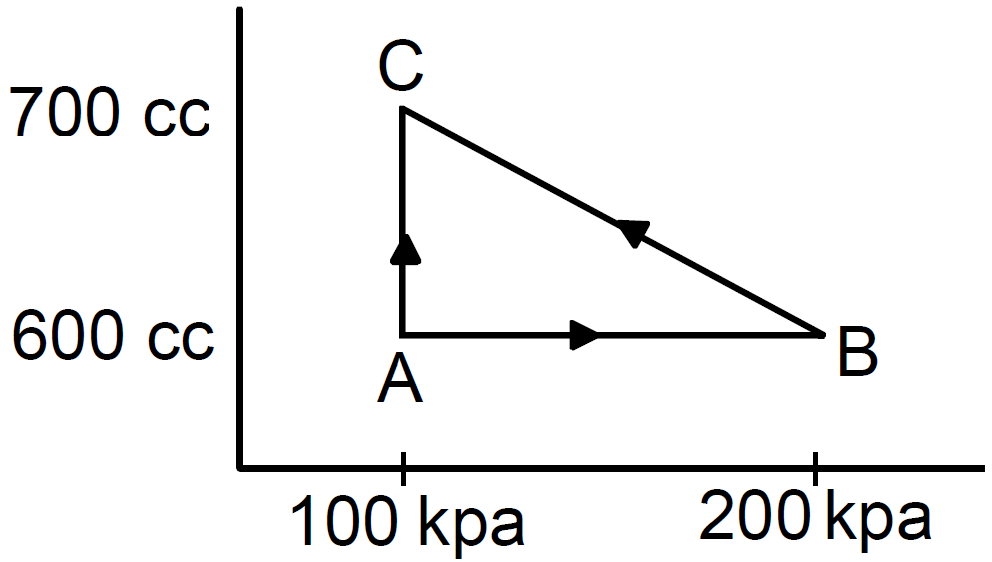
A gas is taken through a cyclic process ABCA as shown in figure. If 2.4 cal of heat is given in the process, what is the value of J?

A progressive wave is given by $\text{y}(\text{x, t})=8\cos(300\text{t}-0.15\text{x})$ where x in m, y in cm and t in second. What is the-
  1. Direction of propagation?
  2. Wavelength?
  3. Frequency?
  4. Wave speed?
  5. Phase difference between two points 0.2m apart?
A spring balance reads 10kg when a bucket of water is suspended from it. What is the reading on the spring balance when:
  1. An ice cube of mass 1.5kg is put into the bucket?
  2. An iron piece of mass 7.8kg suspended by another string is immersed with half its volume inside the water in the bucket (Relative density of iron = 7.8)?
A block of mass 2.0kg is pushed down an inclined plane of inclination 37° with a force of 20N acting parallel to the incline. It is found that the block moves on the incline with an acceleration of 10m/s2. If the block started from rest, find the work done.
  1. By the applied force in the first second.
  2. By the weight of the block in the first second.
  3. By the frictional force acting on the block in the first second. Take g = 10m/s2.
State the kinematic equations for uniformly accelerated motion.
Give the postulates of kinetic theory of gases. Derive the expression for pressure exerted by gas molecules in a container. Use it to relate kinetic energy with pressure.
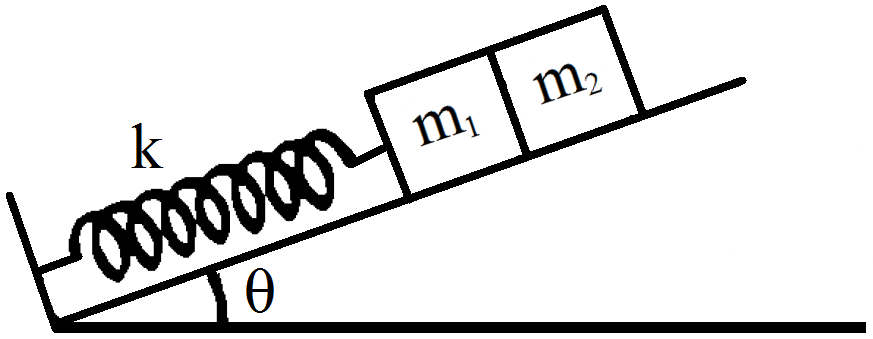
The block of mass m1 shown in figure is fastened to the spring and the block of mass m2 is placed against it.

  1. Find the compression of the spring in the equilibrium position.
  2. The blocks are pushed a further distance $\big(\frac{2}{\text{k}}\big)(\text{m}_1+\text{m}_2)\text{g}\sin\theta$ sine against the spring and released. Find the position where the two blocks separate.
  3. What is the common speed of blocks at the time of separation?

A transverse harmonic wave travelling on a string is described by $\text{y(x, t})=3.0\sin\Big[(36\text{t}+0.018\text{x})+\frac{\pi}{4}\Big]$ where x and y are in cm and t in s. The positive direction of x is from left to right.
  1. What are the speed and direction of propagation of the wave?
  2. What are its amplitude and frequency?
  3. What is the initial phase at the origin?
  4. What is the least distance between two successive crests in the wave?