A particle free to move along the $x-$axis has potential energy given by $U(x) = k[1 - \exp {( - x)^2}]$ for $ - \infty \le x \le + \infty $, where k is a positive constant of appropriate dimensions. Then
IIT 1999,AIIMS 1995, Diffcult


Download our appand get started for free
Experience the future of education. Simply download our apps or reach out to us for more information. Let's shape the future of learning together!No signup needed.*
Similar Questions
- 1The displacement of a particle undergoing $SHM$ of time period $T$ is given by $x(t) = x_m\,cos\, (\omega t + \phi )$. The particle is at $x = -x_m$ at time $t = 0$. The particle is at $x = + x_m$ whenView Solution
- 2A particle is executing $SHM$ along a straight line. Its velocities at distance $x_1$ and $x_2$ from the mean position are $V_1$ and $V_2$ respectively. Its time period isView Solution
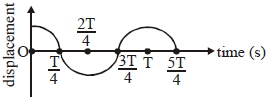
- 3The displacement time graph of a particle executing $S.H.M.$ is given in figure: (sketch is schematic and not to scale) Which of the following statements is are true for this motion?View Solution
$(A)$ The force is zero $t=\frac{3 T}{4}$
$(B)$ The acceleration is maximum at $t=T$
$(C)$ The speed is maximum at $t =\frac{ T }{4}$
$(D)$ The $P.E.$ is equal to $K.E.$ of the oscillation at $t=\frac{T}{2}$
- 4If the time period of a two meter long simple pendulum is $2\, s$, the acceleration due to gravity at the place where pendulum is executing $S.H.M.$ isView Solution
- 5Average velocity of a particle executing $SHM$ in one complete vibration isView Solution
- 6A particle is executing $S.H.M.$ with time period $T^{\prime}$. If time period of its total mechanical energy is $T$ then $\frac{T^{\prime}}{T}$ is ........View Solution
- 7The equation of a particle executing simple harmonic motion is given by $x =\sin \pi\left( t +\frac{1}{3}\right) m$. At $t =1 \,s$, the speed of particle will be .......... $cm s ^{-1}$ (Given : $\pi=3.14$ )View Solution
- 8A particle performs $S.H.M.$ of amplitude $A$ with angular frequency $\omega$ along a straight line. Whenit is at a distance $\frac{{\sqrt 3 }}{2}$ $A$ from mean position, its kinetic energy gets increased by an amount $\frac{1}{2}m{\omega ^2}{A^2}$ due to an impulsive force. Then its new amplitude becomesView Solution
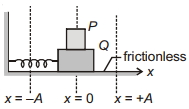
- 9In the figure shown, there is friction between the blocks $P$ and $Q$ but the contact between the block $Q$ and lower surface is frictionless. Initially the block $Q$ with block $P$ over it lies at $x=0$, with spring at its natural length. The block $Q$ is pulled to right and then released. As the spring - blocks system undergoes $S.H.M.$ with amplitude $A$, the block $P$ tends to slip over $Q . P$ is more likely to slip atView Solution
- 10A particle is oscillating according to the equation $X = 7\cos 0.5\pi t$, where $t$ is in second. The point moves from the position of equilibrium to maximum displacement in time ..... $\sec$View Solution