A particle having charge of $1 \,\,C$, mass $1 \,\,kg$ and speed $1 \,\,m/s$ enters a uniform magnetic field, having magnetic induction of $1$ $T,$ at an angle $\theta = 30^o$ between velocity vector and magnetic induction. The pitch of its helical path is (in meters)
Medium


Download our appand get started for free
Experience the future of education. Simply download our apps or reach out to us for more information. Let's shape the future of learning together!No signup needed.*
Similar Questions
- 1View SolutionCurrent flows through uniform, square frames as shown. In which case is the magnetic field at the centre of the frame not zero?
- 2The number of turns of the coil of a moving coil galvanometer is increased in order to increase current sensitivity by $50 \%$. The percentage change in voltage sensitivity of the galvanometer will be $..........\%$View Solution
- 3A long solenoid with $20$ $turns$ per $cm$ is made. To produce a magnetic field of $20$ $millitesla$ inside the solenoid, the necessary current will nearly be......$ampere$View Solution
- 4Two long parallel wires are at a distance $2d$ apart. They carry steady equal currents flowing out of the plane of the paper, as shown. The variation of the magnetic field $B$ along the line $XX’$ is given byView Solution
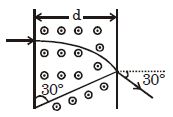
- 5A particle of charge $q$, mass $m$ enters in a region of magnetic field $B$ with velocity $V_0 \widehat i$. Find the value of $d$ if the particle emerges from the region of magnetic field at an angle $30^o$ to its ititial velocity:-View Solution
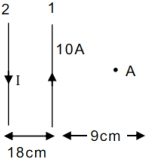
- 6In figure two parallel infinitely long current carrying wires are shown. If resultant magnetic field at point $A$ is zero. Then determine current $I.$ (in $A$)View Solution
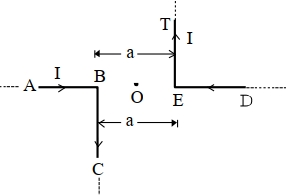
- 7The magnitude of magnetic induction at mid-point $O$ due to current arrangement as shown in Fig will beView Solution
- 8A long, straight wire of radius $a$ carries a current distributed uniformly over its cross-section. The ratio of the magnetic fields due to the wire at distance $\frac{a}{3}$ and $2 a,$ respectively from the axis of the wire isView Solution
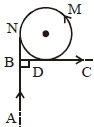
- 9A very long wire $ABDMNDC$ is shown in figure carrying current $I. AB$ and $BC$ parts are straight, long and at right angle. At $D$ wire forms a circular turn $DMND$ of radius $R. AB.$ $\mathrm{BC}$ parts are tangential to circular turn at $\mathrm{N}$ and $D$. Magnetic field at the centre of circle isView Solution
- 10The coil in a moving coil galvanometer experiences torque proportional to current passes through it. If a steady current $i$ is passed through it the steady deflection of the coil is found to be $90^o$ . Now the steady current is switched off and a charge $q$ is suddenly passed through coil. If the coil has $N$ turns of area $A$ and its moment of inertia is $I$ about the axis it is going to rotate then the maximum angle through which it deflects upon passing charge $q$ isView Solution