Question
A particle having mass 10g oscillates according to the equation $\text{x}=(2.0\text{cm})\sin\big[(100\text{s}^{-1})\text{t}+\frac{\pi}{6}\big].$ Find (a) the amplitude, the time period and the spring constant (b) the position, the velocity and the acceleration at t = 0.
Answer

$\text{x}=(2.0\text{cm})\sin\Big[(100\text{s}^{-1})\text{t}+\Big(\frac{\pi}{6}\Big)\Big]$m = 10g.
  1. Amplitude = 2cm
$\omega=100\sec^{-1}$
$\therefore\text{T}=\frac{2\pi}{100}=\frac{\pi}{50}\sec=0.063\sec.$
We know that $\text{T}=2\pi\sqrt{\frac{\text{m}}{\text{k}}}$
$\Rightarrow\text{T}^2=4\pi^2\times\frac{\text{m}}{\text{k}}$
$\Rightarrow\text{k}=\frac{4\pi^2}{\text{T}^2}\text{m}$
$=10^5\text{dyne/cm}=100\text{N/m}$ $\Big[\text{because}\ \omega=\frac{2\pi}{\text{T}}=100\sec^{-1}\Big]$
  1. At t = 0
$\text{x}=2\text{cm}\sin\Big(\frac{\pi}{6}\Big)=2\times\Big(\frac{1}{2}\Big)=1\text{cm}.$ from the mean position.
We know that $\text{x}=\text{A}\sin(\omega\text{t}+\phi)$
$\text{v}=\text{A}\cos(\omega\text{t}+\phi)$
$=2\times100\cos\big(0+\frac{\pi}{6}\big)=200\times\frac{\sqrt{3}}{2}$
$=100\sqrt{3}\sec^{-1}=1.73\text{m/s}$
  1. $\text{a}=-\omega^2\text{x}=100^2\times1$
$=100\text{m/s}^2$

Need a full question paper?

Generate a complete, print-ready paper with questions like this in minutes — across 16+ boards, with answer keys.

Start Generating Free

Similar questions

The amount of charge that passes in time t through a cross-section of a wire is,
$Q(t) = At^2 + Bt + C.$​​​​​​​
  1. Write the dimensional formulae for A, B and C.
  2. If the numerical values of A, B and C are 5, 3 and 1, respectively, in S.I units, find the value of the current at t = 5s.
Consider the situation shown in the figure of the previous problem. Suppose the wire connecting O and C has zero resistance but the circular loop has a resistance R uniformly distributed along its length. The rod OA is made to rotate with a uniform angular speed $\omega$ shown in the figure. Find the current in the rod when $\angle\text{AOC}=90^{\circ}$
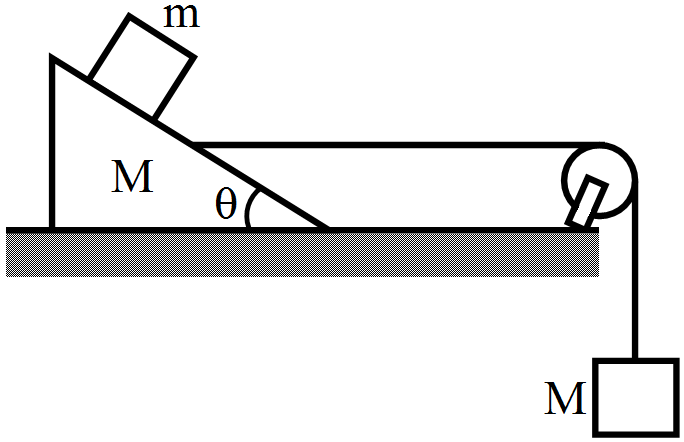
Find the mass M of the hanging block in figure which will prevent the smaller block from slipping over the triangular block. All the surfaces are frictionless and the strings and the pulleys are light.
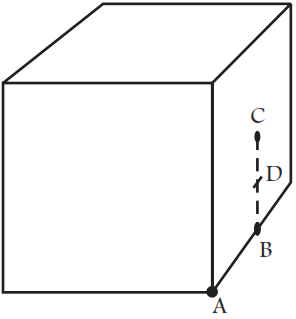
What will be the total flux through the faces of the cube (Fig.) with side of length a if a charge q is placed at:
  1. A: a corner of the cube.
  2. B: mid-point of an edge of the cube.
  3. C: centre of a face of the cube.
  4. D: mid-point of B and C.
In an experiment on photoelectric effect, the stopping potential is measured for monochromatic light beams corresponding to different wavelengths. The data collected are 11s follows:
wavelength (nm) 350 400 450 500 550
stopping potential(V): 1.45 1.00 0.66 0.38 0.16
Plot the stopping potential against inverse of wavelength $\big(\frac{1}{\lambda}\big) $ on a graph paper and find
  1. The Planck constant,
  2. The work function of the emitter and.
  3. The threshold wavelength.
A small bulb is placed at the bottom of a tank containing water to a depth of 80cm. What is the area of the surface of water through which light from the bulb can emerge out? Refractive index of water is 1.33. (Consider the bulb to be a point source).
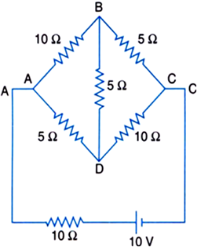
Determine the current in each branch of the network shown in Fig.:
Two coils A and B have inductances 1.0H and 2.0H respectively. The resistance of each coil is $10\Omega.$ Each coil is connected to an ideal battery of emf 2.0V at t = 0 Let $i_A$  and $i_B$ be the currents in the two circuit at time t. Find the ratio $\frac{\text{i}_\text{A}}{\text{i}_\text{B}}$
  1. t = 100ms
  2. t = 200ms
  3. t = 1s.
A particle of charge $2.0 \times 10^{-8}C$ and mass $2.0 \times 10^{-10}g$ is projected with a speed of $2.0 \times 10^3m/s^{-1}$ in a region with a uniform magnetic field of 0.10T. The velocity is perpendicular to the field. Find the radius of the circle formed by the particle and also the time period.
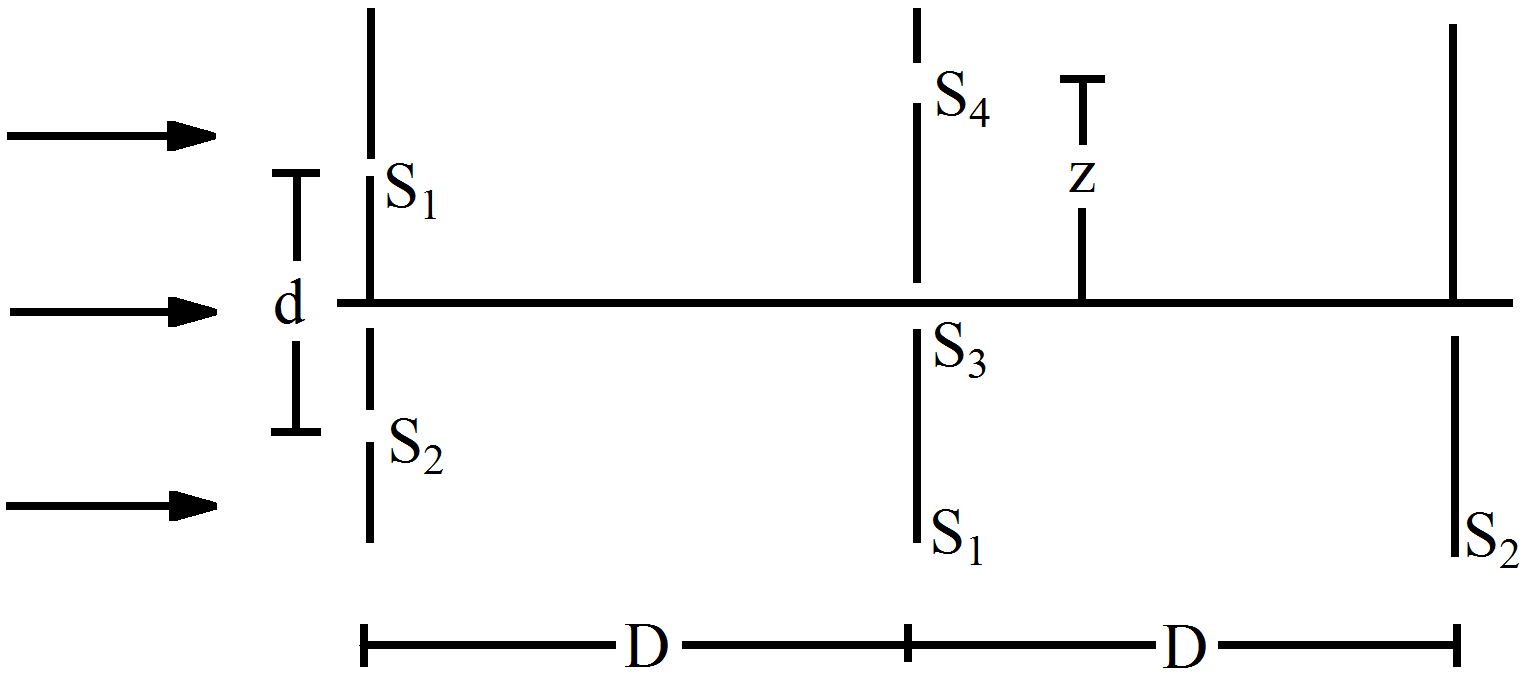
Consider the situation shown in figure (17-E6). The two slits $S_1$ and $S_2 $ p laced symmetrically around the central line are illuminated by a monochromatic light of wavelength $\lambda$. The separation between the slits is d . The light transmitted by the slits falls on a screen $E_1$ placed at a distance $D$ from the slits. The slit $\mathrm{S}_3$ is at the central line and the slit $S_4$ is at a distance $z$ from $S_3$. Another screen $\sum_2$ is placed a further distance $D$ away from $\sum_1$. Find the ratio of the maximum to minimum intensity observed on $\sum_2$, if $z$ is equal to,
  1. $\text{z}=\frac{\lambda\text{D}}{2\text{d}}$
  2. $\frac{\lambda\text{D}}{\text{d}}$
  3. $\frac{\lambda\text{D}}{4\text{d}}$