$A$ particle inside the rough surface of $a$ rotating cone about its axis is at rest relative to it at $a$ height of $1m$ above its vertex. Friction coefficient is $\mu = 0.5$, if half angle of cone is $45^o$, the maximum angular velocity of revolution of cone can be :
Diffcult


Download our appand get started for free
Experience the future of education. Simply download our apps or reach out to us for more information. Let's shape the future of learning together!No signup needed.*
Similar Questions
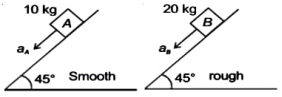
- 1The ratio of acceleration of blocks $A$ placed on smooth incline with block $B$ placed on rough incline is $2: 1$. The coefficient of kinetic friction between block $B$ and incline is .........View Solution
- 2A particle of mass $M$ moves with constant speed along a circular path of radius $ r$ under the action of a force $F$. Its speed isView Solution
- 3Find the maximum velocity for skidding for a car moved on a circular track of radius $100\, m$. The coefficient of friction between the road and tyre is $0.2$ ....... $m/s$View Solution
- 4View SolutionMaximum value of static friction is called
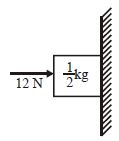
- 5A horizontal force $12 \,N$ pushes a block weighing $1/2\, kg$ against a vertical wall. The coefficient of static friction between the wall and the block is $0.5$ and the coefficient of kinetic friction is $0.35.$ Assuming that the block is not moving initially. Which one of the following choices is correct (Take $g = 10 \,m/s^2$)View Solution
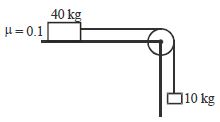
- 6For the given figure find acceleration of $40\, kg$ block ........ $m/s^2$View Solution
- 7A particle moves in a horizontal circle on the smooth inner surface of a hemispherical bowl of radius $R$. The plane of motion is at a depth $d$ below the centre of the hemisphere. The speed of the particle is :-View Solution
- 8A particle of mass $m$ is executing uniform circular motion on a path of radius $r$. If $p$ is the magnitude of its linear momentum. The radial force acting on the particle isView Solution
- 9View SolutionWhen a body is lying on a rough inclined plane and does not move, the force of friction
- 10A block of mass $m$ slides along a floor while a force of magnitude $F$ is applied to it at an angle $\theta$ as shown in figure. The coefficient of kinetic friction is $\mu_{ K }$. Then, the block's acceleration $'a'$ is given by: ($g$ is acceleration due to gravity)View Solution
