A particle of mass $m$ is executing uniform circular motion on a path of radius $r$. If $p$ is the magnitude of its linear momentum. The radial force acting on the particle is
Easy


Download our appand get started for free
Experience the future of education. Simply download our apps or reach out to us for more information. Let's shape the future of learning together!No signup needed.*
Similar Questions
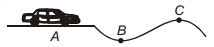
- 1View SolutionA vehicle is moving on a track with constant speed as shown in figure. The apparent weight of the vehicle is
- 2A body of mass $10\, kg$ is lying on a rough plane inclined at an angle of $30^o$ to the horizontal and the coefficient of friction is $0.5$. the minimum force required to pull the body up the plane is ........ $N$View Solution
- 3A block of mass $0.1 \,kg$ is held against a wall by applying a horizontal force of $5\, N$ on the block. If the coefficient of friction between the block and the wall is $0.5$, the magnitude of the frictional force acting on the block is ........ $N$View Solution
- 4If the radius of curvature of the path of two particles of same mass are in the ratio $3:4,$ then in order to have constant centripetal force, their velocities will be in the ratio of:View Solution
- 5View SolutionThe limiting friction between two bodies in contact is independent of
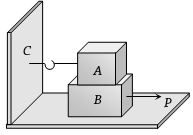
- 6Block $A$ weighing $100$ kg rests on a block $B$ and is tied with a horizontal string to the wall at $C$. Block $B$ weighs $200 \,kg$. The coefficient of friction between $A$ and $B$ is $0.25$ and between $B$ and the surface is $1/3$. The horizontal force $P$ necessary to move the block $B$ should be ........ $N$ $(g = 10\,m/{s^2})$View Solution
- 7A box is lying on an inclined plane what is the coefficient of static friction if the box starts sliding when an angle of inclination is $60^o $View Solution
- 8View SolutionA car is moving with high velocity when it has a turn. A force acts on it outwardly because of
- 9A body of mass $2\,kg$ slides down with an acceleration of $3\,m/s^2$ on a rough inclined plane having a slope of $30^o$ . The external force required to take the same body up the plane with the same acceleration will be ........ $N$ $(g\, = 10\, m/s^2)$View Solution
- 10View SolutionIt is easier to roll a barrel than pull it along the road. This statement is