MCQ
A particle is acted upon by a force of constant magnitude which is always perpendicular to the velocity of the particle, the motion of the particle takes place in a plane. It follows that
  • A
    Its velocity is constant
  • B
    Its acceleration is constant
  • Its kinetic energy is constant
  • D
    It moves in a straight line

Answer

Correct option: C.
Its kinetic energy is constant
c
(c)When a force of constant magnitude which is perpendicular to the velocity of particle acts on a particle, work done is zero and hence change in kinetic energy is zero.

Need a full question paper?

Generate a complete, print-ready paper with questions like this in minutes — across 16+ boards, with answer keys.

Start Generating Free

Similar questions

A bomb of mass $1\ kg$ is thrown vertically upwards with a speed of $100\ m/s.$ After $5$ seconds, it explodes into two fragments. One fragment of mass $400\ gm$ is found to go down with a speed of $25\ m/s.$ What will happen to second fragment just after explosion? $(g = 10\ m/s^2).$
The energy of a given sample of an ideal gas depends only on its:
A wire suspended vertically from one of its ends is stretched by attaching a weight of $200N$ to the lower end. The weight stretches the wire by $1\ mm.$ Then the elastic energy stored in the wire is:
The nature of the work for which an Indian physicist C. V Raman was awarded Nobel Prize was:
$Assertion :$ The isothermal curves intersect each other at a certain point.
$Reason :$ The isothermal change takes place slowly, so, the isothermal curves have very little slope.
Newton's law of motion apply to
Mean free path of a gas molecule is:
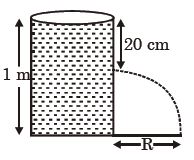
A tank is filled with water upto a height $1\,m$. A hole is made at a distance $20\, cm$ from top. Find, the horizontal distance from the base of the tank, where the water strikes the ground. ......... $cm$
The maximum tension which an inextensible ring of mass $0.1\, kg/m$ can bear is $10\,N$. The maximum velocity in $m/s$ with which it can be rotated is ........ $m/s.$
A body of mass $m$ is projected with velocity $\lambda v_{e}$ in vertically upward direction from the surface of the earth into space. It is given that $v _{ e }$ is escape velocity and $\lambda<1$. If air resistance is considered to the negligible, then the maximum height from the centre of earth, to which the body can go, will be. ( $R$ : radius of earth)