A particle is executing $SHM$ of amplitude $A,$ about the mean position $x = 0.$ Which of the following cannot be a possible phase difference between the positions of the particle at $x = +\,A/2$ and $x = - A/\sqrt {2} .$
Advanced
Download our app for free and get started
The equation for $\operatorname{SHM} x=A \cos (\omega t+\phi)$
When $x=\frac{A}{2}, \Rightarrow \frac{A}{2}=A \cos \left(\omega t+\phi_{1}\right)$
or $60^{\circ}=\omega t+\phi_{1} \ldots . .(1)$
When $x=-\frac{A}{\sqrt{2}}, \Rightarrow-\frac{A}{\sqrt{2}}=A \cos \left(\omega t+\phi_{1}\right)$
or $225^{\circ}=\omega t+\phi_{2} \ldots . .(2)$
$(2)-(1) \Rightarrow \phi_{2}-\phi_{1}=225-60=165^{\circ}$
also $x=A \sin (\omega t+\phi)$
When $x=\frac{A}{2}, \Rightarrow \frac{A}{2}=A \sin \left(\omega t+\phi_{1}\right)$
or $30^{\circ}=\omega t+\phi_{1} \ldots . .(1)$
When $x=-\frac{A}{\sqrt{2}}, \Rightarrow-\frac{A}{\sqrt{2}}=A \sin \left(\omega t+\phi_{1}\right)$
or $225^{\circ}=\omega t+\phi_{2} \ldots . .(2)$
$(2)-(1) \Rightarrow \phi_{2}-\phi_{1}=225-30=195^{\circ}$

Download our appand get started for free
Experience the future of education. Simply download our apps or reach out to us for more information. Let's shape the future of learning together!No signup needed.*
Similar Questions
- 1A particle of mass $m$ undergoes oscillations about $x=0$ in a potential given by $V(x)-\frac{1}{2} k x^2-V_0 \cos \left(\frac{x}{a}\right)$, where $V_0, k, a$ are constants. If the amplitude of oscillation is much smaller than $a$, the time period is given byView Solution
- 2Find the ratio of time periods of two identical springs if they are first joined in series $\&$ then in parallel $\&$ a mass $m$ is suspended from them :View Solution
- 3View SolutionA tunnel has been dug through the centre of the earth and a ball is released in it. It will reach the other end of the tunnel after
- 4The displacement of a body executing $SHM$ is given by $x = A \sin (2\pi t + \pi /3).$ The first time from $t = 0$ when the velocity is maximum is .... $\sec$View Solution
- 5Equations ${y_1} = A\sin \omega t$ and ${y_2} = \frac{A}{2}\sin \omega t + \frac{A}{2}\cos \omega t$ represent $S.H.M.$ The ratio of the amplitudes of the two motions isView Solution
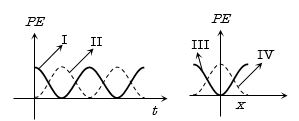
- 6For a particle executing $S.H.M.$ the displacement $x$ is given by $x = A\cos \omega t$. Identify the graph which represents the variation of potential energy $(P.E.)$ as a function of time $t$ and displacement $x$View Solution
- 7The displacement of a particle undergoing $SHM$ of time period $T$ is given by $x(t) = x_m\,cos\, (\omega t + \phi )$. The particle is at $x = -x_m$ at time $t = 0$. The particle is at $x = + x_m$ whenView Solution
- 8View SolutionIdentify the function which represents a periodic motion.
- 9The displacement of a particle moving in $S.H.M.$ at any instant is given by $y = a\sin \omega t$. The acceleration after time $t = \frac{T}{4}$ is (where $T$ is the time period)View Solution
- 10A cylindrical block of wood (density $= 650\, kg\, m^{-3}$), of base area $30\,cm^2$ and height $54\, cm$, floats in a liquid of density $900\, kg\, m^{-3}$ . The block is depressed slightly and then released. The time period of the resulting oscillations of the block would be equal to that of a simple pendulum of length ..... $cm$ (nearly)View Solution