Identify the function which represents a periodic motion.
NEET 2020, Medium


Download our appand get started for free
Experience the future of education. Simply download our apps or reach out to us for more information. Let's shape the future of learning together!No signup needed.*
Similar Questions
- 1A cylindrical plastic bottle of negligible mass of filled with $310\, ml$ of water and left floating in a pond with still water. If pressed downward slightly and released, it starts performing simple harmonic motion at angular frequency $\omega $. If the radius of the bottle is $2.5\, cm$ then $\omega $ is close to ..... $rad\, s^{-1}$ (density of water $= 10^3\, kg/m^3$)View Solution
- 2Displacement between maximum potential energy position and maximum kinetic energy position for a particle executing $S.H.M.$ isView Solution
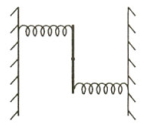
- 3A uniform rod of length $L$ and mass $M$ is pivoted at the centre. Its two ends are attached to two springs of equal spring constants $k$. The springs are fixed to rigid supports as shown in the figure, and the rod is free to oscillate in the horizontal plane. The rod is gently pushed through a small angle $\theta$ in one direction and released. The frequency of oscillation isView Solution
- 4The potential energy of a simple harmonic oscillator at mean position is $2\,joules$. If its mean $K.E.$ is $4\,joules$, its total energy will be .... $J$View Solution
- 5In forced oscillation of a particle the amplitude is maximum for a frequency $\omega_{1}$ of the force, while the energy is maximum for a frequency $\omega_{2}$ of the force, thenView Solution
- 6Two masses $m_1$ and $m_2$ connected by a spring of spring constant $k$ rest on a frictionless surface. If the masses are pulled apart and let go, the time period of oscillation isView Solution
- 7When an oscillator completes $100$ oscillations its amplitude reduced to $\frac{1}{3}$ of initial value. What will be its amplitude, when it completes $200$ oscillations?View Solution
- 8An object of mass $m$ is suspended at the end of a massless wire of length $L$ and area of cross$-$section, $A$. Young modulus of the material of the wire is $Y$. If the mass is pulled down slightly its frequency of oscillation along the vertical direction isView Solution
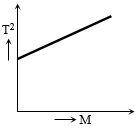
- 9The graph shown was obtained from experimental measurements of the period of oscillations $T$ for different masses $M$ placed in the scale pan on the lower end of the spring balance. The most likely reason for the line not passing through the origin is that theView Solution
- 10Infinite springs with force constant $k$, $2k$, $4k$ and $8k$.... respectively are connected in series. The effective force constant of the spring will beView Solution