MCQ
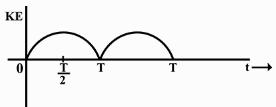
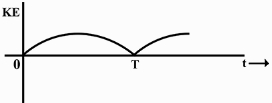
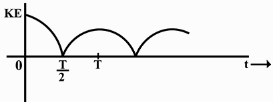
A particle is executing simple harmonic motion with a time period $T.$ At time $t = 0$, it is at its position of equilibrium. The kinetic energy-time graph of the particle will look like
- A
- B
- C
- ✓
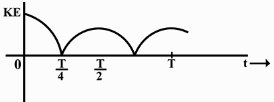
At mean position; $t=0, \omega t=0, y=0, V=V_{\max }=a \omega$
$K . E .=K E_{\max }=\frac{1}{2} m \omega^{2} a^{2}$
At extreme position $: t=\frac{T}{4}, \omega t=\frac{\pi}{2}, y=A, V=V_{\min }=0$
$\therefore \quad K . E .=K E_{\min }=0$
Kinetic energy in $S H M, K E=\frac{1}{2} m \omega^{2}\left(a^{2}-y^{2}\right)$
$=\frac{1}{2} m \omega^{2} a^{2} \cos ^{2} \omega t$
Generate a complete, print-ready paper with questions like this in minutes — across 16+ boards, with answer keys.
