MCQ
$A$ particle is moving in a circle :
  • A
     The resultant force may be towards the centre.
  • B
    The direction of the angular acceleration and the angular velocity must be the same. 
  • C
    The resultant force on the particle must be towards the centre.
  • The cross product of the tangential acceleration and the angular velocity will be zero.
Answer

Correct option: D.
The cross product of the tangential acceleration and the angular velocity will be zero.
d

Need a full question paper?

Generate a complete, print-ready paper with questions like this in minutes — across 16+ boards, with answer keys.

Start Generating Free

Similar questions

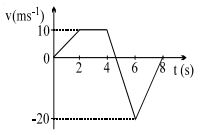
The figure shows a velocity-time graph of a particle moving along a straight line  The correct acceleration-time graph of the particle is shown as
A vessel of volume $0.02 \,\,m^3$ contains a mixture of hydrogen and helium at $20\,^oC$ and $2$ atmospheric pressure. The mass of mixture is $5\,\, gms$. Find the ratio of mass of hydrogen to that of helium in the mixture.
A hearing test is conducted on an aged person. It is found that her thresold of hearing is $20 \,dB$ at $1 \,kHz$  and it rises linearly with frequency to $60 \,dB$ at $9 \,kHz$. The minimum intensity of sound that the person can hear at $5 \,kHz$ is
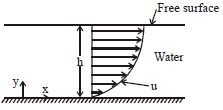
For the situation shown in the figure, water flows on the surface of a fixed plate. The
velocity of water as a function of distance $'y'$ is given as : $u = \alpha \left[ {\frac{y}{h} - 2{{\left( {\frac{y}{h}} \right)}^2}} \right]$ . Determine the magnitude of the shear stress that the water applies at the base of the plate. Coefficient of viscosity is $\eta$
One million electron volt $(1\,MeV)$ is equal to
The displacement $x$ of a particle depend on time $t$ as $x = \alpha {t^{^2}} - \beta {t^3}$ 
If $\vec{\text{a}}_1$ and $\vec{\text{a}}_2$ are two non collinear unit vectors and $|\vec{\text{a}}_1+\vec{\text{a}}_2|=\sqrt{3},$ then the value of $(\vec{\text{a}}_1-\vec{\text{a}}_2).(2\vec{\text{a}}_1+\vec{\text{a}}_2)$ is:
If the density of oxygen is $16$ times that of hydrogen, what will be the ratio of their corresponding velocities of sound waves
If the earth suddenly shrinks (without changing mass) to half of its present radius, the acceleration due to gravity will be
The distance covered by a particle moving with initial velocity and acceleration a in the $x ^{\text {th }}$ second will be :