MCQ
One million electron volt $(1\,MeV)$ is equal to
  • A
    ${10^5}eV$
  • ${10^6}eV$
  • C
    ${10^4}eV$
  • D
    ${10^7}eV$

Answer

Correct option: B.
${10^6}eV$
b
(b) $1\,\,MeV = {10^6}\,eV$

Need a full question paper?

Generate a complete, print-ready paper with questions like this in minutes — across 16+ boards, with answer keys.
Start Generating Free

Similar questions

A spherical solid ball of volume $V$ is made of a material of density $\rho_1$ . It is falling through a liquid of density $\rho_2 (\rho_2 < \rho_1 )$. Assume that the liquid applies a viscous force on the ball that is proportional to the square of its speed $v$, i.e., $F_{viscous}= -kv^2 (k >0 )$,The terminal speed of the ball is 
A solid sphere rolls without slipping on a rough surface and the centre of mass has a  constant speed $v_0$. If the mass of the sphere is $m$ and its radius is $R$, then find  the angular momentum of the sphere about the point of contact
A particle is kept at rest at a distance $R_e ($earth's radius$)$ above the earth's surface. The minimum speed with which it should be projected so that it does not return is $($mass of earth $= M_e)$
The bottoms of utensils for cooking food are blackened to:
As a wave propagates
The first overtone in a closed pipe has a frequency
Cohesive force is experienced between
A force of magnitude $50\, N$ acting along $\widehat i + \widehat j + \widehat k$, displaces a point mass from $(5, 9, 7)$ to $(4, 8, 6)$. The work done by this force during this displacement is :-
The trajectory of a projectile in a vertical plane is $y =\alpha x -\beta x ^{2},$ where $\alpha$ and $\beta$ are constants and $x \& y$ are respectively the horizontal and vertical distances of the projectile from the point of projection. The angle of projection $\theta$ and the maximum height attained $H$ are respectively given by :-
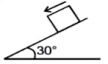
A block of mass $10 \,kg$ is released on rough incline plane. Block start descending with acceleration $2 \,m / s ^2$. Kinetic friction force acting on block is ..... $N$ (take $g=10 \,m / s ^2$ )