Put a uniform meter scale horizontally on your extended index fingers with the left one at $0.00 cm$ and the right one at $90.00 cm$. When you attempt to move both the fingers slowly towards the center, initially only the left finger slips with respect to the scale and the right finger does not. After some distance, the left finger stops and the right one starts slipping. Then the right finger stops at a distance $x_R$ from the center ( $50.00 cm$ ) of the scale and the left one starts slipping again. This happens because of the difference in the frictional forces on the two fingers. If the coefficients of static and dynamic friction between the fingers and the scale are $0.40$ and $0.32$ , respectively, the value of $x_R($ in $cm )$ is. . . . . . .
IIT 2020, Advanced
Download our app for free and get started
Initially
$N _1+ N _2= Mg N _1=\frac{4 Mg }{9}$
$\left(\tau_{ N }=0\right) N _1(50)= N _2(40) N _2=\frac{5 Mg }{9}$
$5 N _1=4 N _2$
$f_{l_k}=\mu_k N_1 \quad f_{l_L}=\mu_S N_1$
$f_{i_k}=0.32 N _1 \quad f_{l_1}=0.4 N _1$
$\overline{f_{2 k}=0.32 N _2} \quad \overline{f_{2 L }=0.4 N _2}$
Suppose $x _{ L }=$ distance of left finger from centre when right finger starts moring
$\left(\tau_{ n }=0\right)_{\text {about cratre }} \Rightarrow N _1 x _{ L }= N _2(40)$
$f_{ K _1}= f _{ L _2} \quad \Rightarrow 0.32 N _1=0.40 N _2$
$4 N _1=5 N _2$
$N _{ I } x _{ L }=\frac{4 N _1}{5}(40)$
$x _{ L }=32$
Now $x _{ R }=$ distance when right finger stops and left finger starts moring
$\left(\tau_{ n }=0\right)_{\text {atout centre }} \Rightarrow N _1 x _{ L }= N _2\left( x _{ R }\right)$
$f _{ L _1}= f _{ K _2} \Rightarrow 0.4 N _1=0.32 N _2$
$5 N _1=4 N _2$
$\frac{4 N _2}{5}(32)= N _2 x _{ R }$
$x _{ R }=\frac{128}{5}=25.6 cm$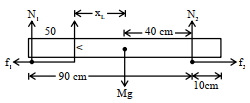

Download our appand get started for free
Experience the future of education. Simply download our apps or reach out to us for more information. Let's shape the future of learning together!No signup needed.*
Similar Questions
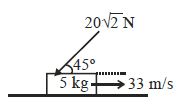
- 1A block of mass $5\, kg$ is kept on a rough horizontal floor. It is given a velocity $33\, m/s$ towards right. A force of $20\sqrt {2\,} \,N$ continuously acts on the block as shown in the figure. If the coefficient of friction between block and floor is $0.5$ the velocity of block after $3\, seconds$ is ........ $m/s$ ($g = 10\, m/s^2$)View Solution
- 2A ball of mass $0.1\, Kg$. is whirled in a horizontal circle of radius $1\, m$. by means of a string at an initial speed of $10\, R.P.M.$ Keeping the radius constant, the tension in the string is reduced to one quarter of its initial value. The new speed is ....... $r.p.m.$View Solution
- 3View SolutionWhich of the following is a self adjusting force?
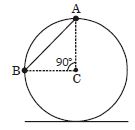
- 4Two beads connected by massless inextensible string are placed over the fixed ring as shown in figure. Mass of each bead is $m$ , and there is no friction between $B$ and ring. Find minimum value of coefficient of friction between $A$ and ring so that system remains in equilibrium. ( $C \to $center of ring, $AC$ line is vertical)View Solution
- 5A piece of ice slides down a rough inclined plane at $\theta=45^{\circ}$ inclination in twice the time that it takes to slide down an identical but frictionless inclined plane. What is the coefficient of friction between ice and incline ?View Solution
- 6A pen of mass $m$ is lying on a piece of paper of mass $M$ placed on a rough table. If the coefficients of friction between the pen and paper and the paper and the table are $\mu_1$ and $\mu_2$, respectively. Then, the minimum horizontal force with which the paper has to be pulled for the pen to start slipping is given byView Solution
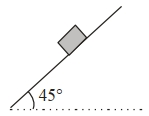
- 7Consider a block kept on an inclined plane (inclined at $45^{\circ}$ ) as shown in the figure. If the force required to just push it up the incline is $2$ times the force required to just prevent it from sliding down, the coefficient of friction between the block and inclined plane $(\mu)$ is equal toView Solution
- 8A block of $200\, g$ mass moves with a uniform speed in a horizontal circular groove, with vertical side walls of radius $20\, cm$. If the block takes $40\, s$ to complete one round, the normal force by the side walls of the groove isView Solution
- 9A bag is gently dropped on a conveyor belt moving at a speed of $2\,m / s$. The coefficient of friction between the conveyor belt and bag is $0.4$ Initially, the bag slips on the belt before it stops due to friction. The distance travelled by the bag on the belt during slipping motion is $.....m$ [Take $g=10\,m / s ^{-2}$ ]View Solution
- 10View SolutionWhen a body is moving on a surface, the force of friction is called