MCQ
A particle is moving in a circle
  • A
    Net force acting on the particle must be toward the centre.
  • B
    The cross product of tangential acceleration and angular velocity will be zero.
  • C
    Angular acceleration and angular velocity will be in the same direction.
  • Net force can be towards the centre.

Answer

Correct option: D.
Net force can be towards the centre.
d
In uniform circular motion, net force is towards centre.

Need a full question paper?

Generate a complete, print-ready paper with questions like this in minutes — across 16+ boards, with answer keys.

Start Generating Free

Similar questions

$N _{2}$ gas is heated from $300\, K$ temperature to $600\, K$ through an isobaric process. Then find the change in entropy of the gas. $( n =1 mole )$ (in $J/K$)
A ball is dropped on the floor from a height of $10 \,m$. It rebounds to a height of $2.5 \,m$. If the ball is in contact with the floor for $0.01 \,sec$, the average acceleration during contact is 
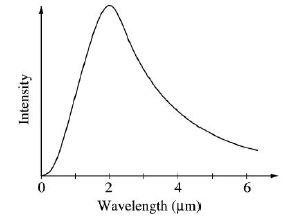
The distribution of relative intensity $I (\lambda)$ of blackbody radiation from a solid  object versus the wavelength $\lambda$ is shown in the figure. If the Wien displacement law  onstant is $2.9 × 10^{-3}\  mK$, what is the approximate temperature of the object ....... $K$
A circular plate of diameter d is kept in contact with a square plate of edge d as show in figure. The density of the material and the thickness are same everywhere. The centre of mass of the composite system will be:
  1. Inside the circular plate.
  2. Inside the square plate.
  3. At the point of contact.
  4. Outside the system.
The maximum horizontal range of a projectile is $400\;m$.The maximum height atteined by it?
A diatomic gas, having $C_{p}=\frac{7}{2} R$ and $C _{ v }=\frac{5}{2} R ,$ is heated at constant pressure. The ratio $dU : dQ : dW :$
A block of rectangular size of mass $m$ and area of cross-section $A$, floats in a liquid of density $\rho$. If we give a small vertical displacement from equilibrium, it undergoes $S H M$ with time period $T$, then
A car starts from rest and moves with uniform acceleration a on a straight road from time $t = 0$ to $t = T$. After that, $a$ constant deceleration brings it to rest. In this process the average speed of the car is
The energy density in the electric field created by a point charge falls off with the distance from the point charge as:

  1. $\frac{1}{\text{r}}$

  2. $\frac{1}{\text{r}^2}$

  3. $\frac{1}{\text{r}^3}$

  4. $\frac{1}{\text{r}^4}$

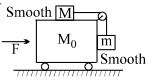
Imagine $a$ situation in which the horizontal surface of block $M_0$ is smooth and its vertical surface is rough with $a$ coefficient of friction $\mu$ Consider a special situation in which both the faces of the block $M_0$ are smooth, as shown in adjoining figure. Mark out the correct statement $(s)$