MCQ
A particle is moving with speed $6\,m/s$ along the direction of  $\vec A = 2\hat i + 2\hat j - \hat k,$ then its velocity is
  • A
    $(4\hat i + 2\hat j - 4\hat k)\,\,units$
  • $(4\hat i + 4\hat j - 2\hat k)\,\,units$
  • C
    $(4\hat i + 4\hat j - 4\hat k)\,\,units$
  • D
    $(2\hat i + 4\hat j - 2\hat k)\,\,units$
Answer

Correct option: B.
$(4\hat i + 4\hat j - 2\hat k)\,\,units$
b
$\overrightarrow{\mathrm{v}} =|\overrightarrow{\mathrm{v}}| \hat{\mathrm{v}} $

$=6\left(\frac{2 \hat{\mathrm{i}}+2 \hat{\mathrm{j}}-\hat{\mathrm{k}}}{3}\right) $

$=4 \hat{\mathrm{i}}+4 \hat{\mathrm{j}}-2 \hat{\mathrm{k}}$

Need a full question paper?

Generate a complete, print-ready paper with questions like this in minutes — across 16+ boards, with answer keys.

Start Generating Free

Similar questions

The components of velocity of a particle are as follows:
$
v_x=(5 t) m / s, v_y=(7 t) m / s
$
The value of acceleration of the particle is :
A car of mass $1000\,kg$ negotiates a banked curve of radius $90\,m$ on a frictionless road. If banking angle is $45^o$ , the maximum speed of car is ............ $m/s$     $[g = 10\,m/s^2]$
A bomb of mass $9 \,kg$ explodes into two pieces of masses $3 \,kg$ and $6 \,kg$. The velocity of mass $3 \,kg$ is $16 \,m / s$. The kinetic energy of mass $6 \,kg$ in joule is
A $ 60 kg$  man runs  up a staircase in $ 12$  seconds while a $ 50 kg$  man runs up the same staircase in $11$ , seconds, the ratio of the rate of doing their work is
A small ball of mass $M$ and density $\rho$ is dropped in a viscous liquid of density $\rho_0$. After some time, the ball falls with a constant velocity. What is the viscous force on the ball ?
If the ratio of radii of two liquid drops is 1 : 2 then the ratio of their pressure excess will be
The velocity of a bus, moving on a smooth road, is increased from $8\ m/ s$ to $32\ m/ s$ in $120s.$ During this process, the potential energy of the bus:
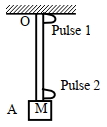
A block $\mathrm{M}$ hangs vertically at the bottom end of a uniform rope of constant mass per unit length. The top end of the rope is attached to a fixed rigid support at $O$. A transverse wave pulse (Pulse $1$ ) of wavelength $\lambda_0$ is produced at point $O$ on the rope. The pulse takes time $T_{O A}$ to reach point $A$. If the wave pulse of wavelength $\lambda_0$ is produced at point $A$ (Pulse $2$) without disturbing the position of $M$ it takes time $T_{A 0}$ to reach point $O$. Which of the following options is/are correct?

(image)

[$A$] The time $\mathrm{T}_{A 0}=\mathrm{T}_{\mathrm{OA}}$

[$B$] The velocities of the two pulses (Pulse $1$ and Pulse $2$) are the same at the midpoint of rope.

[$C$] The wavelength of Pulse $1$ becomes longer when it reaches point $A$.

[$D$] The velocity of any pulse along the rope is independent of its frequency and wavelength.

$A$ and $B$ are two inclined vectors. $R$ is their sum. Choose the correct figure for the given description.
A man slides down a light rope whose breaking strength is $\eta$ times the weight of man $(\eta<1)$. The maximum acceleration of the man so that the rope just breaks is ........