Question
A particle is performing simple harmonic motion along x-axis with amplitude 4.0cm and time period 1.2s. What is the minimum time taken by the particle to move from x = +2cm to x = +4cm and back again?

Answer

As $\text{x = a}\sin\omega\text{t}=\text{a}\sin\frac{2\pi\text{t}}{\text{T}}$

So, $\text{t}=\frac{\text{T}}{2\pi}\sin^{-1}\Big(\frac{\text{x}}{\text{a}}\Big),$ where a = 4cm

At $\text{x}=2,\text{t}=\frac{\text{T}}{2\pi}\sin^{-1}\Big(\frac{2}{4}\Big)$

$=\frac{\text{T}}{2\pi}\times\frac{\pi}{6}=\frac{\text{T}}{12}=\frac{1.2}{12}=\frac{1}{10}$

At $\text{x}=4,\text{t}=\frac{\text{T}}{2\pi}\sin^{-1}\Big(\frac{4}{4}\Big)$

$=\frac{\text{T}}{2\pi}\times\frac{\pi}{2}=\frac{\text{T}}{4}=\frac{1.2}{4}=\frac{3}{10}$

Total Time taken $=\frac{3}{10}-\frac{1}{10}=\frac{2}{5}$

Need a full question paper?

Generate a complete, print-ready paper with questions like this in minutes — across 16+ boards, with answer keys.
Start Generating Free

Similar questions

Write the expressions for Cv and Cp of a gas in terms of gas constant R and constant $\gamma,$ where $\gamma=\frac{\text{C}_\text{P}}{\text{C}_\nu}$
A particle executes the motion described by $\text{x}(\text{t})=\text{x}_0(1-\text{e}^{-\gamma\text{t}});\text{t}\ge0,\text{x}_0>0.$
Where does the particle start and with what velocity?
The output power of the motor of a refrigerator is 240 W . The temperature of the freezing chamber is 240 K and the outside air is 300 K . How much heat can be removed from the freezer in 10 minutes? Assuming that there is ideal efficiency, what is the minimum time in which 10 kg of water at 273 K can be converted in to ice? $J =4.2 \times 10^3 JK cal ^{-1}$.
The sufrace tension and vapour pressure of water at 20°C is 7.28 × 10⁻²N m-1 and 2.33 × 10³ Pa, respectively. What is the radius of the smallest spherical water droplet which can form without evaporating at 20°C?
Two equal charges are placed at a separation of 1.0m. What should be the magnitude of the charges so that the force between them equals the weight of a 50kg person?
A body is projected vertically upwards from A, the top of a tower it reaches the ground in it t1, second. If it is projected vertically downwards from A with the same velocity it reaches the ground in t2 second. If it falls freely, from A, prove that it would reach the ground in $\sqrt{\text{t}_1\text{t}_2}$ second.
A spherical shell made of plastic, contains a charge Q distributed uniformly over its surface. What is the electric field inside the shell? If the shell is hammered to deshape it without altering the charge, will the field inside be changed? What happens if the shell is made of a metal?
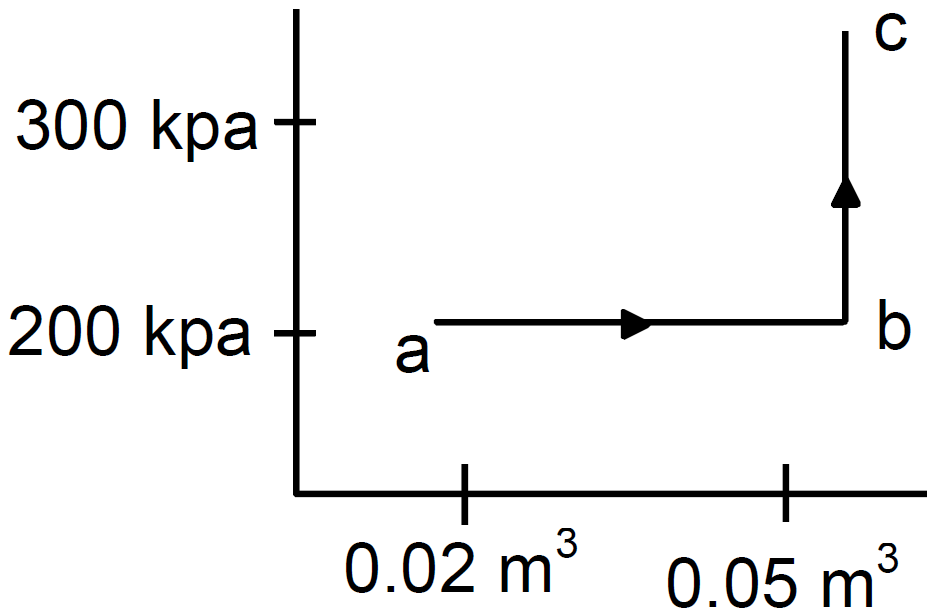
A substance is taken through the process abc as shown in figure. If the internal energy of the substance increases by 5000J and a heat of 2625cal is given to the system, calculate the value of J.

Show that $\text{AB} + \overline{\text{AB}}$ is always 1.
A 100 kg gun fires a ball of 1 kg horizontally from a cliff of height 500 m . It falls on the ground at a distance of 400 m from the bottom of the cliff. Find the recoil velocity of the gun. (acceleration due to gravity $=10 ms^{-2}$ ).