Question
Show that $\text{AB} + \overline{\text{AB}}$ is always 1.

Answer

Given,

$\text{X}=\text{AB} + \overline{\text{AB}}$

Let,

$\text{AB}=\text{y}$

$\therefore\text{X}=\text{y} + \overline{\text{y}}$

$\text{For y} = 0,$

$\text{X}=0+1$

$=1$

$\text{For y} = 1,$

$\text{X}=1+0$

$=1$

thus, X = 1 for all values of y = AB.

Need a full question paper?

Generate a complete, print-ready paper with questions like this in minutes — across 16+ boards, with answer keys.
Start Generating Free

Similar questions

A football is kicked into the air vertically upwards. What is its
  1. acceleration, and
  2. velocity at the highest point?
Just as precise measurements are necessary in science, it is equally important to be able to make rough estimates of quantities using rudimentary ideas and common observations. Think of ways by which you can estimate the following (where an estimate is difficult to obtain, try to get an upper bound on the quantity):
The number of air molecules in your classroom.
A book with many printing errors contains four different formulas for the displacement y of a particle undergoing a certain periodic motion:
  1. $\text{y}=\text{a}\sin2\pi\text{ t/T}$
  2. $\text{y}=\text{a}\sin \text{vt}$
  3. $\text{y}=(\text{a/T})\sin\text{t/a}$
  4. $\text{y}=(\text{a}\sqrt{2})(\sin2\pi\text{t/T}+\cos2\pi\text{t/T})$
(a = maximum displacement of the particle, v = speed of the particle. T = time-period of motion). Rule out the wrong formulas on dimensional grounds.
The surface density (mass/ area) of a circular disc of radius a depends on the distance from the centre as p(r) = A + Br. Find its moment of inertia about the line perpendicular to the plane of the disc through its centre.
Precise measurements of physical quantities are a need of science. For example, to ascertain the speed of an aircraft, one must have an accurate method to find its positions at closely separated instants of time. This was the actual motivation behind the discovery of radar in World War II. Think of different examples in modern science where precise measurements of length, time, mass etc. are needed. Also, wherever you can, give a quantitative idea of the precision needed.
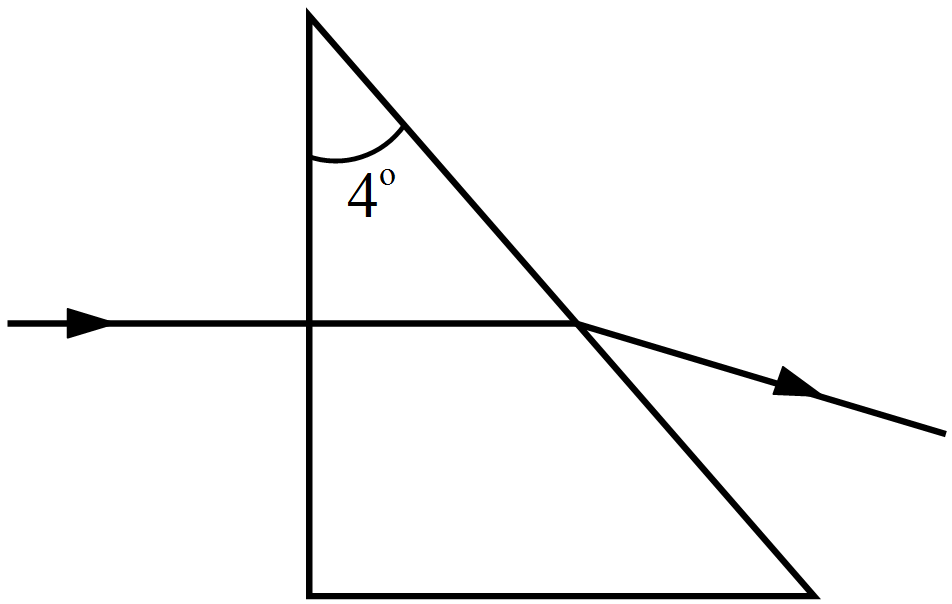
Find the angle of deviation suffered by the light ray shown in figure. The refractive index $\mu=1.5$ for the prism material.

A tuning fork A, marked 512Hz, produces 5 beats per second, where sounded with another unmarked tuning fork B. If B is loaded with wax the number of beats is again 5 per second. What is the frequency of the tuning fork B when not loaded?
A steel wire of original length 1m and cross-sectional area 4.00mm2 is clamped at the two ends so that it lies horizontally and without tension. If a load of 2.16kg is suspended from the middle point of the wire, what would be its vertical depression? Y of the steel = 2.0 × 10¹¹N/m2 Take g = 10m/s2.
Two identical particles, each having a charge of 2.0 × 10-4C and mass of 10g, are kept at a separation of 10cm and then released. What would be the speeds of the particles when the separation becomes large?
A train runs along an unbanked circular track of radius 30m at a speed of 54km/ h. The mass of the train is 106kg. What is the centripetal force required for this purpose? What is the angle of banking required to prevent wearing out of the rail?