MCQ
A particle is projected upwards. The times corresponding to height $h$ while ascending and while descending are $t‌‌_1$ and $t_2$ respectively. The velocity of projection will be
  • A
    $g{t_1}$
  • B
    $g{t_2}$
  • C
    $g\;\left( {{t_1} + {t_2}} \right)$
  • $\frac{{g\left( {{t_1} + {t_2}} \right)}}{2}$
Answer

Correct option: D.
$\frac{{g\left( {{t_1} + {t_2}} \right)}}{2}$
d
(d) If ${t_1}$ and ${t_2}$ are time of ascent and descent respectively then time of flight $T = {t_1} + {t_2} = \frac{{2u}}{g}$

==> $u = \frac{{g({t_1} + {t_2})}}{2}$

Need a full question paper?

Generate a complete, print-ready paper with questions like this in minutes — across 16+ boards, with answer keys.

Start Generating Free

Similar questions

Mark out the correct options.
  1. Diamagnetism occurs in all materials.
  2. Diamagnetism results from the partial alignment of permanent magnetic moment.
  3. The magnetizing field intensity H is always zero in free space.
  4. The magnetic field of induced magnetic moment is opposite to the applied field.
The r.m.s. velocity of a gas is:
A hollow tube is carrying an electric current along its length distributed uniformly over its surface. The magnetic field:
  1. Increases linearly from the axis to the surface.
  2. Is constant inside the tube.
  3. Is zero at the axis.
  4. Is zero just outside the tube.
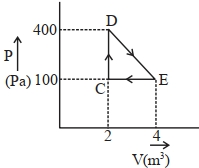
A thermodynamic system is taken through cyclic process. The total work done in the process is $.........\,J$
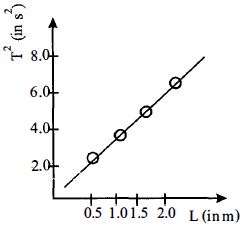
In an experiment for determining the gravitational acceleration $g$ of a place with the help of a simple pendulum, the measured time period square is plotted against the string length of the pendulum in the figure. What is the value of $g$ at the place? ...... $m/s^2$
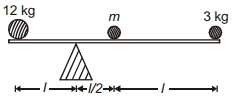
For equilibrium of the system, value of mass $m$ should be .......... $kg$
A body of mass $1\,kg$ is rotating in a vertical circle of radius $1\,m$. What will be the difference in its kinetic energy at the top and bottom of the circle : ............ $\mathrm{J}$ $(g = 10\,m/s^2)$
In a normal operation of a transistor:
  1. The base-emitter junction is forward-biased.
  2. The base-collector junction is forward-biased.
  3. The base-emitter junction is reverse-biased.
  4. The base-collector junction is reverse-biased.
$Assertion :$ For a gas atom the number of degrees of freedom is $3$.
$Reason :$ $\frac{{{C_P}}}{{{C_V}}} = \gamma $
A particle moves on the X-axis according to the equation $\text{x}=\text{x}_0\sin^2\omega\text{t.}$ The motion is simple harmonic.
  1. With amplitude x0
  2. With amplitude 2x0
  3. With time period $\frac{2\pi}{\omega}$.
  4. With time period $\frac{\pi}{\omega}.$