MCQ
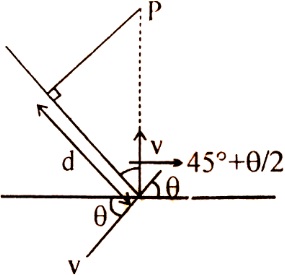
A particle is projected vertically upwards from $O$ with velocity $v$ and a second particle is projected at the same instant from $P$ (at a height h above $O$) with velocity $v$ at an angle of projection $\theta$ . The time when the distance between them is minimum is
  • A
    $\frac{h}{{2v\sin \,\theta }}$
  • B
    $\frac{h}{{2v\cos \,\theta }}$
  • C
    $h/v$
  • $h/2v$

Answer

Correct option: D.
$h/2v$
d
In from of ball thrown from $p$

$v_{\text {resultant }}=2 v \cos \left(\frac{90^{\circ}+\theta}{2}\right)$

$=2 v \cos \left(45^{\circ}+\theta / 2\right)$

$t=\frac{d}{v_{\text {resultant }}}=\frac{h \cos \left(45^{\circ}+\frac{\theta}{2}\right)}{2 v \cos \left(45^{\circ}+\frac{\theta}{2}\right)}=\frac{h}{2 v}$

Need a full question paper?

Generate a complete, print-ready paper with questions like this in minutes — across 16+ boards, with answer keys.

Start Generating Free

Similar questions

An ideal black body at room temperature is thrown into a furnace. It is observed that
The number of degrees of freedom for translatory motion are:
The saturation vapour pressure of water at $100°C$ is ........ $mm$ of mercury
A unit scale is to be prepared whose length does not change with temperature and remains $20\,cm$, using a bimetallic strip made of brass and iron each of different length. The length of both components would change in such a way that difference between their lengths remains constant. If length of brass is $40\,cm$ and length of iron will be$...cm$

$\left(\alpha_{\text {iron }}=1.2 \times 10^{-5} K ^{-1}\right.$ and $\left.\alpha_{\text {brass }}=1.8 \times 10^{-5} K ^{-1}\right)$.

For any two vectors $\overrightarrow A $ and $\overrightarrow B $, if $\overrightarrow A \,.\,\overrightarrow B = \,\,|\overrightarrow A \times \overrightarrow B |,$ the magnitude of $\overrightarrow C = \overrightarrow A + \overrightarrow B $ is equal to
A cube of ice has a iron piece fronzen unside at. The cube floats un a beakerfilled with water, when the ice melts then, the level of water in beaker.
Water is flowing through a tube of non-uniform cross-section. Ratio of the radius at entry and exit end of the pipe is $3$ : $2$. Then the ratio of velocities at entry and exit of liquid is
K is a force constant of a spring. The work done in increasing its extension from l1 to l2 will be:
$A$ small block of mass $m$ is placed on $a$ wedge of mass $M$ as shown, which is initially at rest. All the surfaces are frictionless . The spring attached to the other end of wedge has force constant $k$. If $a'$ is the acceleration of $m$ relative to the wedge as it starts coming down and $A$ is the acceleration acquired by the wedge as the block starts coming down, then  Maximum velocity of $M$ is:
The phenomenon of Browninan movement may be taken as evidence of: