Question
A particle moves on a given straight line with a constant speed v. At a certain time it is at a point P on its straight line path. O is a fixed point. Show that $\overrightarrow{\text{OP}}\times\overrightarrow{\text{v}}$ is independent of the position P.
Answer

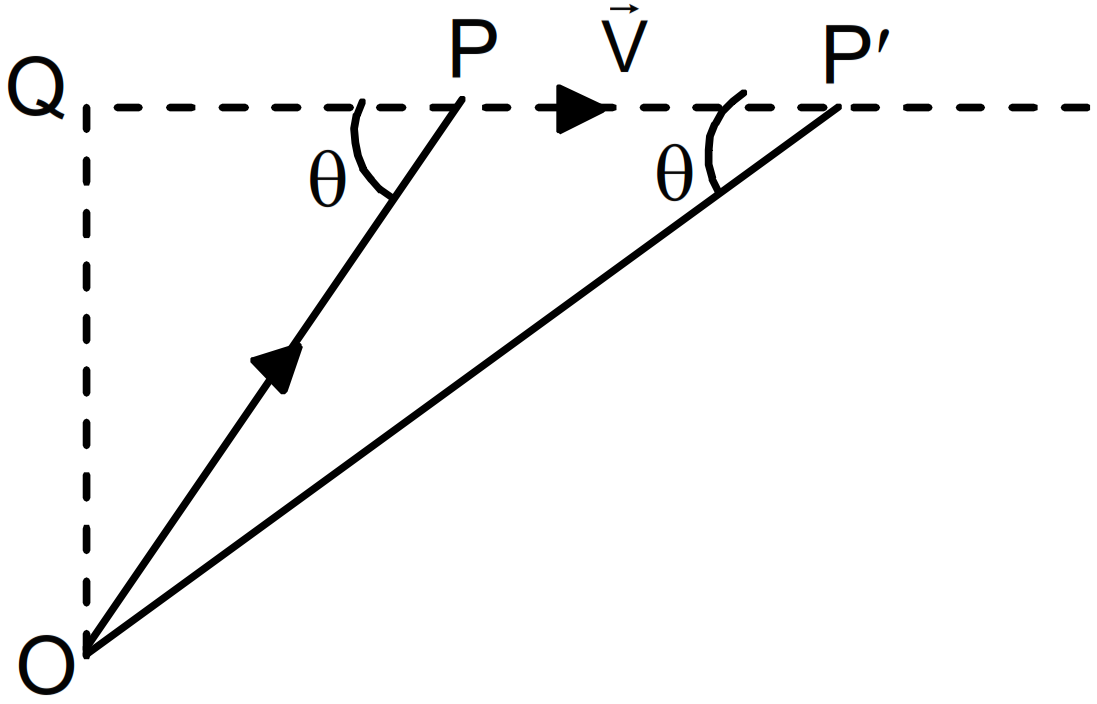
The particle moves on the straight line PP’ at speed v.

From the figure,

$\overrightarrow{\text{OP}}\times\overrightarrow{\text{v}}=(\text{OP})\sin\theta \ \hat{\text{n}}=\text{v(OP)}\sin\theta \ \hat{\text{n}}=\text{v(OQ)} \ \hat{\text{n}}$

It can be seen from the figure, $\text{OQ = OP}\sin\theta=\text{OP}'\sin\theta'$

So, whatever may be the position of the particle, the magnitude and direction of $\overrightarrow{\text{OP}}\times\vec{\text{v}}$ remain constant.

$\therefore\overrightarrow{\text{OP}}\times\vec{\text{v}}$ remain constant.

Need a full question paper?

Generate a complete, print-ready paper with questions like this in minutes — across 16+ boards, with answer keys.

Start Generating Free

Similar questions

The potential difference across the terminals of a battery of emf 12V and internal resistance $2\Omega$ drops to 10V when it is connected to a silver voltameter. Find the silver deposited at the cathode in half an hour. Atomic weight of silver is 107.9g/mole.
A body is being raised to a height h from the surface of earth. What is the sign of work done by
  1. Applied force.
  2. Gravitational force?
At any instant, the coordinates of a particle moving with constant angular speed in a circular path are $x= A \cos \omega t$ and $y= A \sin \omega t$. What is the radius of circular path?
A spring attached with a mass m oscillates with a frequency f. What will be the frequency when the same is taken to the moon? Why?
A car travelling with a speed of 90km/ h on a straight road is ahead of a scooter travelling with a speed of 60km/ h. How would the relative velocity be altered, if scooter is ahead of the car?
A small block B is placed on another block A of mass 5kg and length 20cm. Initially the block B is near the right end of block A. A constant horizontal force of 10N is applied to the block A. All the surfaces are assumed frictionless. Find the time elapsed before the block B separates from A.

It is said that the separation between the two charges forming an electric dipole should be small. Small compared to what?
Define S.H.M. what are its characteristics? At what distance from the mean position in S.H.M. of amplitude 'r', the energy is half kinetic and half potential?
A steel wire and a copper wire of equal length and equal cross-sectional area are joined end to end and the combination is subjected to a tension. Find the ratio of.
  1. The stresses developed in the two wires.
  2. The strains developed. Y of steel = 2 × 10¹¹N/m2. Y of copper =  1.3 × 10¹¹N/m2.
Write the differential equation and two difference of time period in linear and angular simple harmonic motion.