Question
A particle moves with a constant velocity parallel to the X-axis. Its angular momentum with respect to the origin:
  1. Is zero.
  2. Remains constant.
  3. Goes on Increasing.
  4. Goes on decreasing.

Answer

  1. Remains constant.

Explanation:

For angular momentum. we have:

$\overrightarrow{\text{L}}=\text{m}\Big(\overrightarrow{\text{r}}\times\overrightarrow{\text{v}}\Big)$

$\overrightarrow{\text{v}}=\text{v}\hat{\text{i}}$ and $\overrightarrow{\text{r}}=\text{x}\hat{\text{i}}+\text{y}\hat{\text{j}}$

So, $\overrightarrow{\text{L}}=-\text{mvy}\hat{\text{k}}$

m, v and y are constant; therefore, angular momentum remains constant.

Need a full question paper?

Generate a complete, print-ready paper with questions like this in minutes — across 16+ boards, with answer keys.

Start Generating Free

Similar questions

If the tension in the cable supporting an elevator is equal to the weight of the elevator, the elevator may:
If m mass of a substance undergoes a phase change, then amount of heat required will be:
Parallel rays of light of intensity $I =912 \ Wm ^{-2}$ are incident on a spherical balck body kept in surroundings of temperature $300 \ K$. Take Stefan-Boltzmann constant $\sigma=5.7 \times 10^{-8} Wm ^{-2} K ^{-4}$ and assume that the energy exchange with the surroundings is only through radiation. Th final steady state temperature of the black body is close to:
A particle is tied to $20\, cm$ long string. It performs circular motion in vertical plane. What is the angular speed of particle when the tension in the string at the top is  zero   ......... $rad/sec$
Roads are banked on curves so that
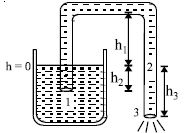
Figure shows a siphon. Choose the wrong statement:

($P_0$ = atmospheric pressure)

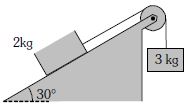
In the arrangement shown, the $2\, kg$ block is held to keep the system at rest. The  string and pulley are ideal. When the $2\, kg$ block is set free, by what amount the  tension in the string changes? $[ g = 10\, m/s^2]$
Two bodies of masses ${m_1}$ and ${m_2}$ have equal kinetic energies. If ${p_1}$ and ${p_2}$ are their respective momentum, then ratio ${p_1}:{p_2}$ is equal to
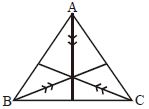
Three particles $A, B$ & $C$ of equal mass move with speed $V$ as shown to strike at  centroid of equilateral triangle after collision. $A$ comes to rest & $B$ retraces its path  with speed $V$. speed of $C$ after collision is :-
A river is flowing from west to east at a speed of $8\,m$ per min. A man on the south bank of the river, capable of swimming at $20\,m / min$ in still water, wants to swim across the river in the shortest time. He should swim in a direction