Question
A particle moves with constant angular velocity in a circle. During the motion its

Answer

(a)In uniform circular motion (constant angular velocity) kinetic energy remains constant but due to change in velocity of particle its momentum varies.

Need a full question paper?

Generate a complete, print-ready paper with questions like this in minutes — across 16+ boards, with answer keys.
Start Generating Free

Similar questions

In a streamline flow
When a particle moves in a uniform circular motion. It has
In Young's double slit experiment, the distance between the two slits is $0.1 \,mm$, the distance between the slits and the screen is $1 \,m$ and the wavelength of the light used is $600 \,nm$. The intensity at a point on the screen is $75 \%$ of the maximum intensity. smallest distance ................ $\,mm$ of this point from the central fringe
The value of contact angle for kerosene with solid surface ........ $^o$
Two masses $M_{A}$ and $M_{B}$ are hung from two strings of length $l_{A}$ and $l_{B}$ respectively. They are executing SHM with frequency relation $f_{A}=2 f_{B}$, then relation
$\mathop {{C_6}{H_6}O}\limits_{phenol} $ $\xrightarrow[\begin{subarray}{l} 
  3{H_2}(High\,\,temp \\ 
  and\,\,pressure) 
\end{subarray} ]{{Ni}}(A)\xrightarrow{{Cu}}(B)$ $\xrightarrow{{N{H_2}OH}}(C)\xrightarrow{{{H^ \oplus }}}$ $(D)\xrightarrow{{H{O^ - }}}(E)$

Product $(E) $ is

The length, tension, diameter and density of a wire $B$ are double than the corresponding quantities for another stretched wire $A$. Then.
Let $T_{1}$ and $T_{2}$ be the energy of an electron in the first and second excited states of hydrogen atom, respectively. According to the Bohr's model of an atom, the ratio $T _{1}: T _{2}$ is
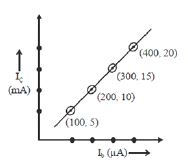
The transfer characteristic curve of a transistor, having input and output resistance $100\,\Omega $ and $100\,k\Omega $ respectively, is shown in the figure. The Voltage and Power gain, are respectively
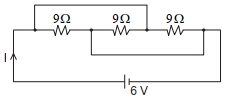
The current $I$ flowing through the given circuit will be $.....A$.