MCQ
A particle moves with constant angular velocity in circular path of certain radius and is acted upon by a certain centripetal force $F$. if the angular velocity is kept same but the radius of the path is halved, the new force will be
  • A
    $2F$
  • B
    ${F^2}$
  • $F/2$
  • D
    $F/4$

Answer

Correct option: C.
$F/2$
c
(c) $F = m{\omega ^2}R$ $\therefore$ $F \propto R$ ($m$ and $\omega$ are constant)

If radius of the path is halved, then force will also become half.

Need a full question paper?

Generate a complete, print-ready paper with questions like this in minutes — across 16+ boards, with answer keys.

Start Generating Free

Similar questions

The radius of gyration of a rotating metallic disc is independent of which of the following physical quantity.
What is the torque of the force $\mathop F\limits^ \to   = (2\hat i - 3\hat j + 4\hat k)N$ acting at the pt. $\mathop r\limits^ \to   = (3\hat i + 2\hat j + 3\hat k)\,m$ about the origin
A particle is moving in a circular path of radius $r$ under the action of a force $F$. If at an instant velocity of particle is $v$, and speed of particle is increasing, then
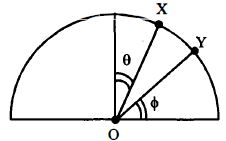
A particle is released on a vertical smooth semicircular track from point $X$ so that $OX$ makes angle $\theta $ from the vertical ( see figure). The normal reaction of the track on the particle vanishes at point $Y$ where $OY$ makes angle $\phi $ with the horizontal. Then
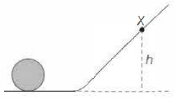
A solid sphere rolls without slipping, first horizontally and then up to a point $X$ at height $h$ on an inclined plane before rolling down, as shown in the figure below. The initial horizontal speed of the sphere is
The total momentum of the molecules of $1 \,gm$ $mol$ of a gas in a container at rest of $300 \,K$ is
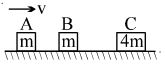
Three blocks are initially placed as shown in the figure. Block $A$ has mass $m$ and initial velocity $v$ to the right. Block $B$ with mass $m$ and block $C$ with mass $4m$ are both initially at rest. Neglect friction. All collisions are elastic. The final velocity of block $A$ is
A spherical drop of water has radius $1\, mm$ If surface tension of water is $70 \times {10^{ - 3}}\,N/m$ difference of pressures between inside and out side of the spherical drop is ........ $N/{m^{ - 2}}$
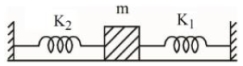
A mass $m$ is attached to two springs as shown in figure. The spring constants of two springs are $K _1$ and $K _2$. For the frictionless surface, the time period of oscillation of mass $m$ is
Figure. shows two processes A and B on a system. Let $\Delta\text{Q}_1$ and $\Delta\text{Q}_2$ be the heat given to the system in processes A and B respectively. Then,