A particle moving in a magnetic field increases its velocity, then its radius of the circle
Easy


Download our appand get started for free
Experience the future of education. Simply download our apps or reach out to us for more information. Let's shape the future of learning together!No signup needed.*
Similar Questions
- 1A Rowland ring of mean radius $15\; cm\;3500$ turns of wire wound on a ferromagnetic core of relative permeability $800.$ What is the magnetic field $B$ (in $T$) in the core for a magnetizing current of $1.2\; A?$View Solution
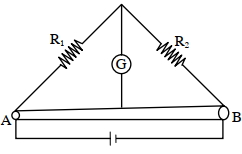
- 2Two resistances $R_1=X \Omega$ and $R_2=1 \Omega$ are connected to a wire $A B$ of uniform resistivity, as shown in the figure. The radius of the wire varies linearly along its axis from $0.2 mm$ at $A$ to $1 mm$ at $B$. A galvanometer ($G$) connected to the center of the wire, $50 cm$ from each end along its axis, shows zero deflection when $A$ and $B$ are connected to a battery. The value of $X$ is. . . . .View Solution
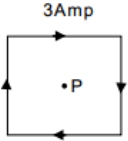
- 3Find magnetic field at centre $P$ if length of side of square loop is $20\, cm$View Solution
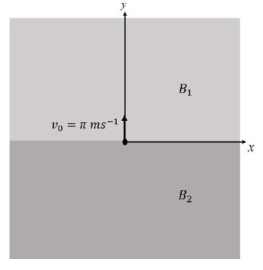
- 4In the xy-plane, the region $y >0$ has a uniform magnetic field $B_1 \hat{k}$ and the region $y<0$ has another uniform magnetic field $B_2 \hat{k}$. A positively charged particle is projected from the origin along the positive $y$-axis with speed $v _0=\pi m s ^{-1}$ at $t =0$, as shown in the figure. Neglect gravity in this problem. Let $t = T$ be the time when the particle crosses the $x$-axis from below for the first time. If $B_2=4 B_1$, the average speed of the particle, in $m s ^{-1}$, along the $x$-axis in the time interval $T$ is. . . . . .View Solution
- 5When a $12\,\Omega $ resistor is connected with a moving coil galvanometer then its deflection reduces from $50$ divisions to $10$ divisions. The resistance of the galvanometer is ............. $\Omega $View Solution
- 6View SolutionAn electron and a proton enter a magnetic field perpendicularly. Both have same kinetic energy. Which of the following is true
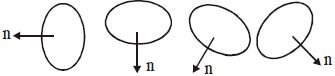
- 7Figure represents four positions of a current carrying coil is a magnetic field directed towards right. $\hat n$ represent the direction of area of vector of the coil. The correct order of potential energy isView Solution
- 8To Verify Ohm's law, a student is provided with a test resistor $\mathrm{R}_{\mathrm{T}}$, a high resistance $\mathrm{R}_1$, a small resistance $\mathrm{R}_2$, two identical galvanometers $\mathrm{G}_1$ and $\mathrm{G}_2$, and a variable voltage source $\mathrm{V}$. The correct circuit to carry out the experiment isView Solution
- 9A wire of length $L$ is bent in the form of a circular coil and current $i$ is passed through it. If this coil is placed in a magnetic field then the torque acting on the coil will be maximum when the number of turns isView Solution
- 10An electron moves through a uniform magnetic field $\vec{B}=B_0 \hat{i}+2 B_0 \hat{j} T$. At a particular instant of time, the velocity of electron is $\overrightarrow{\mathrm{u}}=3 \hat{i}+5 \hat{j} \mathrm{~m} / \mathrm{s}$. If the magnetic force acting on electron is $\overrightarrow{\mathrm{F}}=5 \mathrm{ekN}$, where $e$ is the charge of electron, then the value of $\mathrm{B}_0$ is ____$\mathrm{T}$.View Solution