Two very long, straight, parallel wires carry steady currents $I$ and $-I$ respectively. The distance etween the wires is $d$. At a certain instant of time, a point charge $q$ is at a point equidistant from the two wires, in the plane of the wires. Its instantaneous velocity $v$ is perpendicular to the plane of wires. The magnitude of the force due to the magnetic field acting on the charge at this instant is
Medium


Download our appand get started for free
Experience the future of education. Simply download our apps or reach out to us for more information. Let's shape the future of learning together!No signup needed.*
Similar Questions
- 1Two long conductors, separated by a distance $d$ carry current $I_1$ and $I_2$ in the same direction. They exert a force $F$ on each other. Now the current in one of them is increased to two times and its directions is reversed. The distance is also increased to $3d$. The new value of the force between them isView Solution
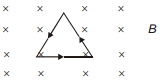
- 2A wire is bent in the form of an equilateral triangle of side $100 \,cm$ and carries a current of $2 \,A$. It is placed in a magnetic field of induction $2.0 \,T$ directed perpendicular into the plane of paper. The direction and magnitude of magnetic force acting on each side of the triangle will beView Solution
- 3A cell of emf $90\,V$ is connected across series combination of two resistors each of $100\,\Omega$ resistance. A voltmeter of resistance $400\,\Omega$ is used to measure the potential difference across each resistor. The reading of the voltmeter will be $.........\,V$View Solution
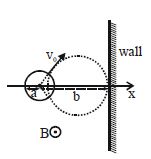
- 4An electron is projected normally from the surface of a sphere with speed $v_0$ in a uniform magnetic field perpendicular to the plane of the paper such that its strikes symmetrically opposite on the sphere with respect to the $x-$ axis. Radius of the sphere is $'a'$ and the distance of its centre from the wall is $'b'$ . What should be magnetic field such that the charge particle just escapes the wallView Solution
- 5Two identical conducting wires $A$ and $B$ of same dimensions and same material are bent in the form of circular coil. Wire $A$ consists of single turn whereas wire $B$ consists of $2\, turns$. Both these wires are then suspended in a uniform magnetic field with their planes parallel to the one another and same current is passed through them. Which statement is correct ?View Solution
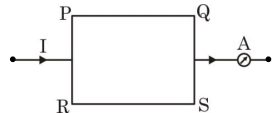
- 6The magnetic induction in air at a point $1\,cm $ away from a long wire that carries a current of $1\,A$, will beView Solution
- 7If the angular momentum of an electron is $\overrightarrow {J\,} $ then the magnitude of the magnetic moment will beView Solution
- 8In given figure, $X$ and $Y$ are two long straight parallel conductors each carrying a current of $2\,\, A.$ The force on each conductor is $F$ newtons. When the current in each is changed to $1\, A $ and reversed in direction, the force on each is nowView Solution

- 9View SolutionField inside a solenoid is
- 10A current carrying rectangular loop PQRS is made of uniform wire. The length $PR = QS =5\,cm$ and $PQ = RS =100\,cm$. If ammeter current reading changes from I to $2 I$, the ratio of magnetic forces per unit length on the wire $P Q$ due to wire RS in the two cases respectively $f_{ PQ }^{ I }: f_{ PQ }^{2 I }$ is :View Solution