A particle of charge $q$ and mass $m$ is moving along the $x$ -axis with a velocity $v$ and enters a region of electric field $E$ and magnetic field $B$ as shown in figure below for which figure the net force on the charge may be zero
Medium
Download our app for free and get started
(b) The charge will not experience any force if $|\overrightarrow {{F_e}} |\, = \,|\overrightarrow {{F_m}} |$. This condition is satisfied in option $(b)$ only.

Download our appand get started for free
Experience the future of education. Simply download our apps or reach out to us for more information. Let's shape the future of learning together!No signup needed.*
Similar Questions
- 1View SolutionIn a current carrying long solenoid, the field produced does not depend upon
- 2Two concentric coils $X$ and $Y$ of radii $16 \,\,cm$ and $10 \,\,cm$ lie in the same vertical plane containing $N-S$ direction. $X$ has $20$ $turns$ and carries $16 \,\,A.$ $Y$ has $25$ $turns$ $\&$ carries $18\,A$. $X$ has current in anticlockwise direction and $Y$ has current in clockwise direction for an observer, looking at the coils facing the west. The magnitude of net magnetic field at their common centre isView Solution
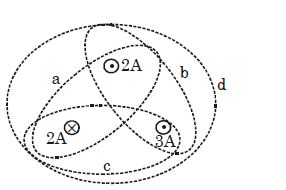
- 3Rank the value of $\oint {\vec B.\overrightarrow {dl} } $ for the closed paths shown in figure from the smallest to largestView Solution
- 4A galvanometer having a coil resistance of $60\,\Omega $ shows full scale deflection when a current of $1.0\, amp$ passes through it. It can be converted into an ammeter to read currents upto $5.0\, amp$ byView Solution
- 5A galvanometer of resistance $25\,\Omega $ gives full scale deflection for a current of $10$ milliampere, is to be changed into a voltmeter of range $100\, V$ by connecting a resistance of $‘R’$ in series with galvanometer. The value of resistance $R$ in $\Omega $ isView Solution
- 6The radius of a circular loop is $r$ and a current $i$ is flowing in it. The equivalent magnetic moment will beView Solution
- 7View SolutionWhich particles will have minimum frequency of revolution when projected with the same velocity perpendicular to a magnetic field
- 8A charged particle moves with velocity $v$ in a uniform magnetic field $\overrightarrow B $. The magnetic force experienced by the particle isView Solution
- 9Two identical conducting wires $A$ and $B$ of same dimensions and same material are bent in the form of circular coil. Wire $A$ consists of single turn whereas wire $B$ consists of $2\, turns$. Both these wires are then suspended in a uniform magnetic field with their planes parallel to the one another and same current is passed through them. Which statement is correct ?View Solution
- 10View SolutionA charged particle moves in a uniform magnetic field. The velocity of the particle at some instant makes an acute angle with the magnetic field. The path of the particle will be