A particle of charge $q$ and mass $m$ is subjected to an electric field $E = E _{0}\left(1- ax ^{2}\right)$ in the $x-$direction, where $a$ and $E _{0}$ are constants. Initially the particle was at rest at $x=0 .$ Other than the initial position the kinetic energy of the particle becomes zero when the distance of the particle from the origin is
JEE MAIN 2020, Diffcult
Download our app for free and get started
$E = E _{0}\left(1- ax ^{2}\right)$
$W =\int q E\, d x = q E _{0} \int_{0}^{ x _{0}}\left(1- ax ^{2}\right) dx$
$=q E_{0}\left[x_{0}-\frac{a x_{0}^{3}}{3}\right]$
For $\Delta KE =0, \quad W =0$
Hence $x _{0}=\sqrt{\frac{3}{ a }}$

Download our appand get started for free
Experience the future of education. Simply download our apps or reach out to us for more information. Let's shape the future of learning together!No signup needed.*
Similar Questions
- 1An electric charge $10^{-3}\ \mu C$ is placed at the origin $(0, 0)$ of $X-Y$ coordinate system. Two points $A$ and $B$ are situated at $(\sqrt 2 ,\sqrt 2 )$ and $(2, 0)$ respectively. The potential difference between the points $A$ and $B$ will be......$V$View Solution
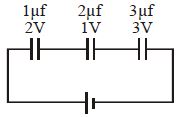
- 2The diagram shows three capacitors with their capacitances and with breakdown voltages. What should be the maximum value of external $emf$ of source such that no capacitor breaks downView Solution
- 3Two capacitors connected in parallel having the capacities ${C_1}$ and ${C_2}$ are given $'q'$ charge, which is distributed among them. The ratio of the charge on ${C_1}$ and ${C_2}$ will beView Solution
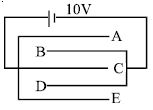
- 4Five identical capacitor plates are arranged such that they make capacitors each of $2\ \mu F$. The plates are connected to a source of $emf$ $10\ V$. The charge on plate $C$ is......$ \mu C$View Solution
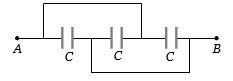
- 5Three equal capacitors, each with capacitance $C$ are connected as shown in figure. Then the equivalent capacitance between $A$ and $B$ isView Solution
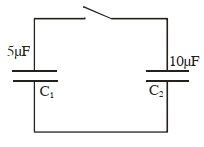
- 6A capacitor $C _{1}$ of capacitance $5\,\mu F$ is charged to a potential of $30\,V$ using a battery. The battery is then removed and the charged capacitor is connected to an uncharged capacitor $C _{2}$ of capacitance $10\,\mu F$ as shown in figure. When the switch is closed charge flows between the capacitors. At equilibrium, the charge on the capacitor $C _{2}$ is________ $\mu C$View Solution
- 7capacitor is used to store $24\, watt\, hour$ of energy at $1200\, volt$. What should be the capacitance of the capacitorView Solution
- 8The electric field near a conducting surface having a uniform surface charge density $\sigma $ is given byView Solution
- 9$A$ and $B$ are two identical spheres charge on them is $7\,\mu C$ and $1\,\mu C$ respectively. Now both are connected by a wire. Calculate flow of charge from $A$ to $B$......$\mu C$View Solution
- 10A capacitor is connected to a battery of voltage $V$. Now a di electric slab of dielectric constant $k$ is completely inserted between the plates, then the final charge on the capacitor will beView Solution
(If initial charge is $q_{0}$ )