A capacitor is connected to a battery of voltage $V$. Now a di electric slab of dielectric constant $k$ is completely inserted between the plates, then the final charge on the capacitor will be
(If initial charge is $q_{0}$ )
AIIMS 2019, Medium


Download our appand get started for free
Experience the future of education. Simply download our apps or reach out to us for more information. Let's shape the future of learning together!No signup needed.*
Similar Questions
- 1Consider a thin spherical shell of radius $R$ with its centre at the origin, carrying uniform positive surface charge density. The variation of the magnitude of the electric field $|\vec{E}(r)|$ and the electric potential $V(r)$ with the distance r from the centre, is best represented by which graph?View Solution
- 2The mean free path of electrons in a metal is $4 \times 10^{-8} \;m$. The electric field which can give on an average $2 \;eV$ energy to an electron in the metal will be in units of $V / m$View Solution
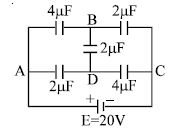
- 3The figure shows a diagonal symmetric arrangement of capacitors and a battery. If the potential of $C$ is zero, thenView Solution
- 4After the switch shown in figure $A$ is closed, there is current $i$ through resistance $R$. Figure $B$ indicates current variation curves $a, b, c$ and $d$ for four sets of values of $R$ and capacitance $C$:View Solution
$(i)$ $R_0$ and $C_0$, $(ii)$ $2R_0$ and $C_0$,
$(iii)$ $R_0$ and $2C_0$, $(iv)$ $2R_0$ and $2C_0$.
Which set goes with which curve?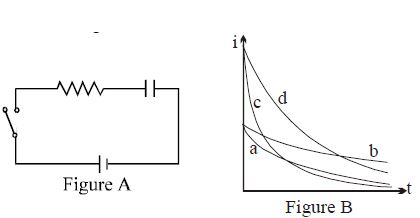
- 5View SolutionThe charge given to any conductor resides on its outer surface, because
- 6If some charge is given to a solid metallic sphere, the field inside remains zero and by Gauss's law all the charge resides on the surface. Now, suppose that Coulomb's force between two charges varies as $1 / r^{3}$. Then, for a charged solid metallic sphereView Solution
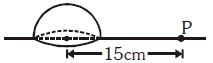
- 7Figure shows a solid hemisphere with a charge of $5\ nC$ distributed uniformly through its volume. The hemisphere lies on a plane and point $P$ is located on this plane, along a radial line from the centre of curvature at distance $15\ cm$. The electric potential at point $P$ due to the hemisphere, is .....$V$View Solution
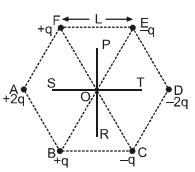
- 8Six point charges are kept at the vertices of a regular hexagon of side $L$ and centre $O$, as shown in the figure. Given that $K=\frac{1}{4 \pi \varepsilon_0} \frac{q}{L^2}$, which of the following statement $(s)$ is (are) correct?View Solution
$(A)$ the elecric field at $O$ is $6 K$ along $O D$
$(B)$ The potential at $O$ is zero
$(C)$ The potential at all points on the line $PR$ is same
$(D)$ The potential at all points on the line $ST$ is same.
- 9Given below are two statements: one is labelled aView Solution
Assertion $(A)$ and the other is labelled as Reason$(R)$
$Assertion$ $(A)$ : Work done by electric field on moving a positive charge on an equipotential surface is always zero.
$Reason$ $(R)$ : Electric lines of forces are always perpendicular to equipotential surfaces.
In the light of the above statements, choose the most appropriate answer from the options given below
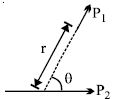
- 10View SolutionTwo short electric dipoles are placed as shown. The energy of electric interaction between these dipoles will be