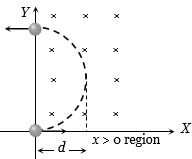
A particle of charge $q$ and mass $m$ moving with a velocity $v$ along the $x$-axis enters the region $x > 0$ with uniform magnetic field $B$ along the $\hat k$ direction. The particle will penetrate in this region in the $x$-direction upto a distance $d$ equal to
Easy


Download our appand get started for free
Experience the future of education. Simply download our apps or reach out to us for more information. Let's shape the future of learning together!No signup needed.*
Similar Questions
- 1Ratio of electric and magnetic field due of moving point charge if its speed is $4.5 \times 10^{5} \;m / s$View Solution
- 2The oscillator frequency of a cyclotron is $10 \,MHz$. What should be the operating magnetic field for accelerating proton is ......... $T$View Solution
- 3A charged particle of mass $m$ and charge $q$ travels on a circular path of radius $r$ that is perpendicular to a magnetic field $B$. The time taken by the particle to complete one revolution isView Solution
- 4Two charges of same magnitude move in two circles of radii $R_1=R$ and $R_2=2 R$ in a region of constant uniform magnetic field $B _0$. The work $W_1$ and $W_2$ done by the magnetic field in the two cases respectively, are such thatView Solution
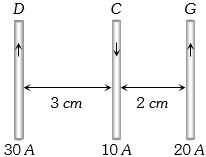
- 5Three long, straight parallel wires carrying current, are arranged as shown in figure. The force experienced by a $25\, cm$ length of wire $C$ isView Solution
- 6A charged particle carrying charge $1\,\mu C$ is moving with velocity $(2 \hat{ i }+3 \hat{ j }+4 \hat{ k })\, ms ^{-1} .$ If an external magnetic field of $(5 \hat{ i }+3 \hat{ j }-6 \hat{ k }) \times 10^{-3}\, T$ exists in the region where the particle is moving then the force on the particle is $\overline{ F } \times 10^{-9} N$. The vector $\overrightarrow{ F }$ is :View Solution
- 7Two long parallel wires are at a distance of $1$ metre. Both of them carry one ampere of current. The force of attraction per unit length between the two wires isView Solution
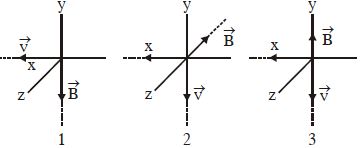
- 8The figure shows three situations when an electron moves with velocity $\vec v$ travels through a uniform magnetic field $\vec B$. In each case, what is the direction of magnetic force on the electronView Solution
- 9A long straight wire of radius a carries a steady current $i$. The current is uniformly distributed across its cross section. The ratio of the magnetic field at $ a/2$ and $2a$ isView Solution
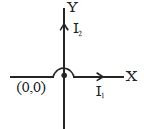
- 10Two long straight conductors with currents $I_1$ and $I_2$ are placed along $X$ and $Y-$ axes. The equation of locus of points of zero magnetic induction isView Solution