Two long parallel wires are at a distance of $1$ metre. Both of them carry one ampere of current. The force of attraction per unit length between the two wires is
AIPMT 1998, Medium


Download our appand get started for free
Experience the future of education. Simply download our apps or reach out to us for more information. Let's shape the future of learning together!No signup needed.*
Similar Questions
- 1A magnetic needle suspended parallel to a magnetic field requires $\sqrt 3\,J $ of work to turn it through $60^o$. The torque needed to maintain the needle in this position will beView Solution
- 2A current carrying wire of length $L$ is transformed into a coil of $N$ turns. To achieve maximum magnetic moment, the coilView Solution
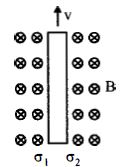
- 3Consider a thin metallic sheet perpendicular to the plane of the paper moving with speed $'v'$ in a uniform magnetic field $B$ going into the plane of the paper (See figure). If charge densities ${\sigma _1}$ and ${\sigma _2}$ are induced on the left and right surfaces, respectively, of the sheet then (ignore fringe effects)View Solution
- 4The magnetic force acting on charged particle of charge $2\,\mu C$ in magnetic field of $2\, T$ acting in $y-$ direction , when the particle velocity is $\left( {2\hat i + 3\hat j} \right) \times {10^6}\,m{s^{ - 1}}$ isView Solution
- 5An $\alpha$-particle (mass $4 amu$ ) and a singly charged sulfur ion (mass $32 amu$ ) are initially at rest. They are accelerated through a potential $V$ and then allowed to pass into a region of uniform magnetic field which is normal to the velocities of the particles. Within this region, the $\alpha$-particle and the sulfur ion move in circular orbits of radii $r_\alpha$ and $r_5$, respectively. The ratio $\left(r_s / r_\alpha\right)$ is. . . . .$(4)$View Solution
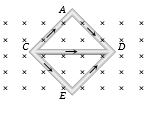
- 6Same current $i = 2A$ is flowing in a wire frame as shown in figure. The frame is a combination of two equilateral triangles $ACD$ and $CDE$ of side $1\,m$. It is placed in uniform magnetic field $B = 4T$ acting perpendicular to the plane of frame. The magnitude of magnetic force acting on the frame is.......$N$View Solution
- 7View SolutionIf an ammeter is connected in parallel to a circuit, it is likely to be damaged due to excess
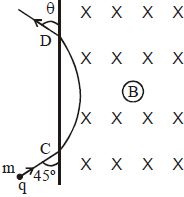
- 8A particle of mass $m = 1.67 \times 10^{-27}\, kg$ and charge $q = 1.6 \times 10^{-19} \, C$ enters a region of uniform magnetic field of strength $1$ $tesla$ along the direction shown in the figure. If the direction of the magnetic field is along the outward normal to the plane of the paper, then the time spent by the particle in the region of the magnetic field after entering it at $C$ is nearly :-......$ns$View Solution
- 9A steady current $I$ goes through a wire loop $\mathrm{PQR}$ having shape of a right angle triangle with $\mathrm{PQ}=3 x, \mathrm{PR}=4 x$ and $\mathrm{QR}=5 x$. If the magnitude of the magnetic field at $\mathrm{P}$ due to this loop is $k\left(\frac{\mu_0 I}{48 \pi x}\right)$, find the value of $k$.View Solution
- 10A current is flowing through a thin cylindrical shell of radius $R$. If energy density in the medium, due to magnetic field, at a distance $r$ from axis of the shell is equal to $U$ then which of the following graphs is correctView Solution