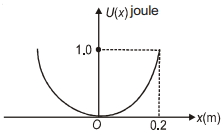
A particle of mass $4 \,kg$ moves simple harmonically such that its $P E(U)$ varies with position $x$, as shown. The period of oscillations is ............
Medium
Download our app for free and get started
(d)
Mass $=4 \,kg$
Maximum $P.E.$ $=\frac{1}{2} k A^2$
$1=\frac{1}{2} \times k \times(0.2)^2$
$\frac{2}{0.04}=k$
$k=50 \,N / m$
$T=2 \pi \sqrt{\frac{m}{k}}$
$T=2 \pi \sqrt{\frac{4}{50}}$
$=\frac{2 \sqrt{2} \pi}{5} \,s$

Download our appand get started for free
Experience the future of education. Simply download our apps or reach out to us for more information. Let's shape the future of learning together!No signup needed.*
Similar Questions
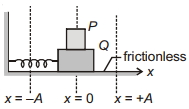
- 1In the figure shown, there is friction between the blocks $P$ and $Q$ but the contact between the block $Q$ and lower surface is frictionless. Initially the block $Q$ with block $P$ over it lies at $x=0$, with spring at its natural length. The block $Q$ is pulled to right and then released. As the spring - blocks system undergoes $S.H.M.$ with amplitude $A$, the block $P$ tends to slip over $Q . P$ is more likely to slip atView Solution
- 2As a body performs $S.H.M.$, its potential energy $U.$ varies with time as indicated inView Solution
- 3Springs of spring constants $K, 2K, 4K, 8K,$ ..... are connected in series. A mass $40\, gm$ is attached to the lower end of last spring and the system is allowed to vibrate. What is the time period of oscillation ..... $\sec$. (Given $K = 2\, N/cm$)View Solution
- 4A particle with restoring force proportional to displacement and resisting force proportional to velocity is subjected to a force $F\sin \omega t$. If the amplitude of the particle is maximum for $\omega = {\omega _1}$ and the energy of the particle is maximum for $\omega = {\omega _2}$, then (where ${\omega _0}$ natural frequency of oscillation of particle)View Solution
- 5If a spring of stiffness $k$ is cut into two parts $A$ and $B$ of length $l_{A}: l_{B}=2: 3$, then the stiffness of spring $A$ is given byView Solution
- 6Time period of a particle executing $SHM$ is $8\, sec.$ At $t = 0$ it is at the mean position. The ratio of the distance covered by the particle in the $1^{st}$ second to the $2^{nd}$ second is :View Solution
- 7The velocity of a particle executing SHM varies with displacement $( x )$ as $4 v ^2=50- x ^2$. The time period of oscillations is $\frac{x}{7} s$. The value of $x$ is $............$ $\left(\right.$ Take $\left.\pi=\frac{22}{7}\right)$View Solution
- 8The period of oscillation of a simple pendulum of length $L$ suspended from the roof of a vehicle which moves without friction down an inclined plane of inclination $\alpha$, is given byView Solution
- 9The potential energy of a particle $\left(U_x\right)$ executing $S.H.M$. is given byView Solution
- 10A body of mass $0.01 kg$ executes simple harmonic motion $(S.H.M.)$ about $x = 0$ under the influence of a force shown below : The period of the $S.H.M.$ is .... $s$View Solution