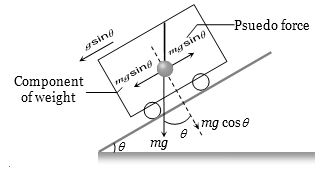
The period of oscillation of a simple pendulum of length $L$ suspended from the roof of a vehicle which moves without friction down an inclined plane of inclination $\alpha$, is given by
IIT 2000,JEE MAIN 2022, Medium


Download our appand get started for free
Experience the future of education. Simply download our apps or reach out to us for more information. Let's shape the future of learning together!No signup needed.*
Similar Questions
- 1A particle moves such that its acceleration $a$ is given by $a = - bx$, where $x$ is the displacement from equilibrium position and b is a constant. The period of oscillation isView Solution
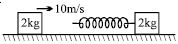
- 2A $2\, Kg$ block moving with $10\, m/s$ strikes a spring of constant $\pi ^2 N/m$ attached to $2\, Kg$ block at rest kept on a smooth floor. The time for which rear moving block remain in contact with spring will be ... $\sec$View Solution
- 3A particle executes $S.H.M.$ according to equation $x=10( cm ) \cos \left[2 \pi t+\frac{\pi}{2}\right]$, where $t$ is in second. The magnitude of the velocity of the particle at $t=\frac{1}{6} \,s$ will be .............. $cm / s$View Solution
- 4$Assertion :$ In $SHM$, acceleration is always directed towards the mean position.View Solution
$Reason :$ In $SHM$, the body has to stop momentary at the extreme position and move back to mean position. - 5A particle execute $S.H.M.$ along a straight line. The amplitude of oscillation is $2 \,cm$. When displacement of particle from the mean position is $1 \,cm$, the magnitude of its acceleration is equal to magnitude of its velocity. The time period of oscillation is ........View Solution
- 6A particle is executing simple harmonic motion with a time period $T.$ At time $t = 0$, it is at its position of equilibrium. The kinetic energy-time graph of the particle will look likeView Solution
- 7The displacement time equation of a particle executing $SHM$ is : $x = A \,sin\,(\omega t + \phi )$. At time $t = 0$ position of the particle is $x = A/2$ and it is moving along negative $x-$ direction. Then the angle $\phi $ can beView Solution
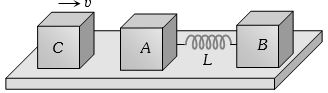
- 8Two blocks $A$ and $B$ each of mass m are connected by a massless spring of natural length L and spring constant $K$. The blocks are initially resting on a smooth horizontal floor with the spring at its natural length as shown in figure. A third identical block $C$ also of mass $m$ moves on the floor with a speed $v$ along the line joining $A$ and $B$ and collides with $A$. ThenView Solution
- 9A particle is performing simple harmonic motion with amplitude A and angular velocity ${\omega }$. The ratio of maximum velocity to maximum acceleration isView Solution
- 10Out of the following functions representing motion of a particle which represents $SHM$View Solution
$(A)\;y= sin\omega t-cos\omega t$
$(B)\;y=sin^3\omega t$
$(C)\;y=5cos\left( {\frac{{3\pi }}{4} - 3\omega t} \right)$
$(D)\;y=1+\omega t+{\omega ^2}{t^2}$