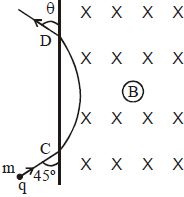
A particle of mass $m = 1.67 \times 10^{-27}\, kg$ and charge $q = 1.6 \times 10^{-19} \, C$ enters a region of uniform magnetic field of strength $1$ $tesla$ along the direction shown in the figure. The speed of the particle is $10^7\, m/s.$ The magnetic field is directed along the inward normal to the plane of the paper. The particle enters the field at $C$ and leaves at $D.$ Then the angle $\theta$ must be :-.........$^o$
Medium


Download our appand get started for free
Experience the future of education. Simply download our apps or reach out to us for more information. Let's shape the future of learning together!No signup needed.*
Similar Questions
- 1An electron having mass $m$ and kinetic energy $K$ enter in uniform magnetic field $B$ perpendicularly, then its frequency will beView Solution
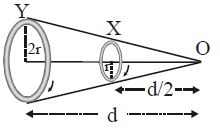
- 2Two circular coils $X$ and $Y$, having equal number of turns, carry equal currents in the same sence and subtend same solid angle at point $O$. If the smaller coil $X$ is midway between $O$ and $Y$, and If we represent the magnetic induction due to bigger coil $Y$ at $O$ as $B_Y$ and that due to smaller coil $X$ at $O$ as $B_X$, then $\frac{{{B_Y}}}{{{B_X}}}$ isView Solution
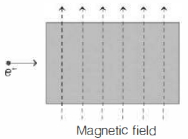
- 3View SolutionAn electron enters a chamber in which an uniform magnetic field is present as shown in figure. Ignore gravity. During its motion inside the chamber
- 4Two particles $\mathrm{X}$ and $\mathrm{Y}$ having equal charges are being accelerated through the same potential difference. Thereafter they enter normally in a region of uniform magnetic field and describes circular paths of radii $R_1$ and $R_2$ respectively. The mass ratio of $\mathrm{X}$ and $\mathrm{Y}$ is :View Solution
- 5A circular loop has a radius of $5\, cm$ and it is carrying a current of $0.1\, amp$. Its magnetic moment isView Solution
- 6View SolutionThe electron in the beam of a television tube move horizontally from south to north. The vertical component of the earth's magnetic field points down. The electron is deflected towards
- 7A steel wire has a magnetic moment $M.$ What will be its magnetic moment if it is bent into a semi-circular arc ?View Solution
- 8A proton is accelerating in a cyclotron where the applied magnetic field is $2 \,T$. If the potential gap is effectively $100 \,kV$ then how much revolutions the proton has to make between the "dees" to acquire a kinetic energy of $20 \,MeV$ ?View Solution
- 9The resistance of a galvanometer is $50\, ohm$ and the maximum current which can be passed through it is $0.002\, A$. What resistance must be connected to it in order to convert it into an ammeter of range $0 -0.5\, A$ ?....$ohm$View Solution
- 10Currents of a $10\, ampere$ and $2\, ampere$ are passed through two parallel thin wires $A$ and $B$ respectively in opposite directions. Wire $A$ is infinitely long and the length of the wire $B$ is $2\, m$. The force acting on the conductor $B$, which is situated at $10\, cm$ distance from $A$ will beView Solution