If $n$ drops, each of capacitance $C$, coalesce to form a single big drop, then the ratio of the energy stored in the big drop to that in each small drop will be
Medium


Download our appand get started for free
Experience the future of education. Simply download our apps or reach out to us for more information. Let's shape the future of learning together!No signup needed.*
Similar Questions
- 1Twenty seven drops of same size are charged at $220\, \mathrm{~V}$ each. They combine to form a bigger drop. Calculate the potential of the bigger drop. (In $\mathrm{~V}$)View Solution
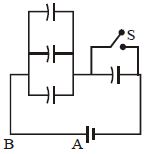
- 2Four capacitors of capacitance $10\,mF$ and a battery of $200\,V$ are arranged as shown. How much charge will flow through $AB$ after the switch $S$ is closed .....$\mu C$View Solution
- 3Two charged parallel plate capacitors, each with separation between plates equal to $d$, are separated by a large distance $L >> d$. Then the force of interaction between them is proportional toView Solution
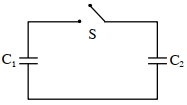
- 4Two capacitors having capacitance $C _{1}$ and $C _{2}$ respectively are connected as shown in figure. Initially, capacitor $C _{1}$ is charged to a potential difference $V$ volt by a battery. The battery is then removed and the charged capacitor $C_{1}$ is now connected to uncharged capacitor $C _{2}$ by closing the switch $S$. The amount of charge on the capacitor $C _{2}$, after equilibrium isView Solution
- 5When a positive $q$ charge is taken from lower potential to a higher potential point, then its potential energy willView Solution
- 6View SolutionPolar molecules are the molecules:
- 7For a charged spherical ball, electrostatic potential inside the ball varies with $r$ as $V =2 ar ^2+ b$. Here, $a$ and $b$ are constant and $r$ is the distance from the center. The volume charge density inside the ball is $-\lambda a \varepsilon$. The value of $\lambda$ is $...........$. $\varepsilon=$ permittivity of medium.View Solution
- 8A parallel plate capacitor of capacitance $C$ has spacing $d$ between two plates having area $A$. The region between the plates is filled with $N$ dielectric layers, parallel to its plates, each with thickness $\delta=\frac{ d }{ N }$. The dielectric constant of the $m ^{\text {th }}$ layer is $K _{ m }= K \left(1+\frac{ m }{ N }\right)$. For a very large $N \left(>10^3\right)$, the capacitance $C$ is $\alpha\left(\frac{ K \varepsilon_0 A }{ d \;ln 2}\right)$. The value of $\alpha$ will be. . . . . . . .View Solution
[ $\epsilon_0$ is the permittivity of free space]
- 9View SolutionAssertion : Two equipotential surfaces cannot cut each other.
Reason : Two equipotential surfaces are parallel to each other.
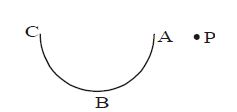
- 10In the following diagram the work done in moving a point charge from point $P$ to point $A, B$ and $C$ is respectively as $W_A,\, W_B$ and $W_C$, then (there is no charge nearby)View Solution